20 July 2008

Raindrops on ...

... well I don't have any roses yet (and that would be far too clichéed), so will have to celebrate the rain we've had today with some other plants.

French marigold:Raindrops on French marigold

Asparagus ferns:Raindrops on asparagus ferns

Broccoli leaf:Raindrops on cabbage leaf

Corn silks (this is a bi-coloured variety - I didn't realise that the silks would be bi-coloured too!):
Raindrops on corn tassels

I thought the broccoli leaf was my favourite, but the corn silks look so completely wanton (especially after having read the posts by the Matron and Amy earlier today), that I think I've changed my mind.

18 July 2008

This week's mistakes

I discovered on Wednesday that the Riesentraube tomatoes I'd been thinking were a bush-type plant, were not, and that I should have been taking out the side shoots all this time. So I spent a good hour this afternoon thinning them back to their main stems - discovering a chilli plant and an eggplant that had been taken over by them in the meantime. The tomato plants look a lot better now - they were getting terribly congested before and I was worried that they'd be susceptible to blight.

The two Parisian Pickling plants still seemed to be only sporting immature cucumbers. Then I noticed that they had somehow produced fruit underneath the layer of mulch. So instead of the mini gherkins/cornichons I was expecting I had three monster cucumbers (the zucchini (Striata d'Italia) on the left are five inches long):

I'll be watching them much more closely from now on. Anyone got a good recipe for using up overgrown gherkins?

17 July 2008

Meteorological meanings

Weather forecast for Friday 18 July 2008I'm confused about the long-term weather forecast from the Weather Network. I understand that we might be seeing storms on Friday and on Saturday. But what struck me as odd was the distinction between a thunderstorm and a thunder-shower (and the necessity for a hyphen in one but not the other). It seems that the former is used for a more severe storm, although the US National Weather Service explains (slightly disdainfully, I think) that technically there is no difference and that:

In fact, in order to avoid confusion, we in the National Weather Service do not use the term "thundershower". If a shower is strong enough to produce lightning, even just one single bolt, it's called a thunderstorm.

The difference between a risk and a chance of seeing one or the other is more puzzling. You might think that a 60% probability of precipitation (P.O.P.) compared to 40% might explain the difference in terminology, but apparently not, as today's forecast talks about chance at both percentages:

Forecast for Thursday 17 July 2008
So I think it must come down to a difference in perceived levels of danger - thunderstorms being something inherently risky, while thundershowers are less so? Maybe I'm spending far too much time worrying about this...

Red wiggly livestock

Warning: this entry features tales of mass-murder by neglect and ravenous rodents and scenes of decomposition.


Posts by fellow bloggers Gayla and Rach have inspired me to get around to re-stocking the wormery that I bought in England four or five years ago. This gadget has had a rather chequered history. My first batch of worms tried their hardest to escape and had to be collected regularly from the floor of the garage and returned to their new home. They must have had forebodings of the dreadful calamity that befell them a few months later, when the tap on the base of the wormery got blocked and the worms, which had all fallen through to the lower section, drowned in their own nutritious 'worm tea'.

I kept the wormery outside for the second batch and it worked better - I covered the bottom of the lowest layer with some carpet to stop the worms falling through into the base and covered the tap to stop it from getting blocked again. All went well and the worms did their thing, producing lovely vermicompost and worm tea for the garden. So, with my vermicultural credentials established, I ordered more worms to go into my garden compost bin. That worked well too, until one day I noticed that all the worms had gone. Then I started to find rat-droppings near the compost bin and realised that we had a new resident. I'll never forget the piercing squeal that the rat gave when we evicted it (Mike thought it was me screaming at the sight of the rat. I still haven't quite forgiven him for thinking that.). Chicken wire underneath the compost bin stopped the rat coming back.

I couldn't bring the surviving worms with me when we moved to Canada, as customs officials are a bit fussy about soil crossing international boundaries. I had to thoroughly disinfect the wormery (and all my garden tools) so that there was no trace of English earth on anything. I stank of Jeyes Fluid for a week after that! Since we got to Canada the wormery has been sitting empty in the garage, so it was about time that I did something about it.

Wormery
The Can-O-Worms wormery comes with three layers for the worms to live in. You start off using just two: in the bottom layer goes bedding material for the worms. This time I've put a lining of fly-screen netting over the bottom of this layer to stop the worms falling into the base, which is where the moisture collects. On top of the netting is partially-composted kitchen waste from the rotating composter that's out in the garden (which we've finally got the hang of - it needs a lot more water than a regular compost bin).

Partially-rotted compost in wormery

Then the half-pound of worms went in with the shredded paper and soil that they had arrived in. I only ordered them two days before: I still think it's a bit strange that you can send live worms through the post.

Worms in wormery
The next layer went on top, ready to be filled with green kitchen waste. As the worms finish up the food in the lower layer, they'll move up to feast on the gently rotting waste in this layer. As that gets filled, you can add the final layer and eventually use the compost in the bottom layer, which the worms will have left and which will be fully decomposed and wonderful for the garden.
Top layer on wormery

15 July 2008

Mullein mêlée

The flower stalks of the mulleins are starting to produce their yellow blooms. They are proving popular with the wildlife - two blue orchard mason bees were sharing this one with a dragonfly this morning.

Dragonfly and blue orchard mason bees on a mullein flower

13 July 2008

Greenhouse = divorce?

If you don't hear from me for a while, it may be because I'm consulting divorce lawyers. We have started work on building the greenhouse (in this context I use 'we' in the opposite sense to the Royal We: to mean mostly 'he'). It is a BIG greenhouse and I think will take a month or two for us to put together. Here are some of its constituent parts, looking rather like the aftermath of a dinosaur dig:


The instructions seem to assume that you've spent your entire life putting up structures like this, so it will be nothing short of a miracle if we can get this thing up and still be talking to each other by the end of it.

10 July 2008

Rhubarb explosion

The tyre garden for asparagus and rhubarb was a bit of an experiment born out of necessity. It seems to be working OK, though. Here was one of the brand-new rhubarb plants back on May 4th:

Rhubarb shoots

And here is how it looks at the moment:

Rhubarb thriving

I know you're not supposed to pick rhubarb in its first year, but, by gum, it's tempting!

07 July 2008

Giant toilet roll invasion

Water tanks on the drive
Three more big water tanks arrived today and had to be rolled up to the barn. Here are the children demonstrating the required dung-beetle technique:

Kids pushing water tank
And here is their father showing how not to do it:

06 July 2008

Potato pride

First ever potato harvestI wasn't at all sure whether we should be digging up the potato plants yet, but really wanted some potatoes for lunch. A couple of the Yukon Gold potatoes were suffering from early blight, so we targetted those and were pleased to find a fair few small potatoes. These were leftover supermarket potatoes, rather than seed potatoes - perhaps that's why they got blight? We also pulled up one of the Kennebec plants and got a better haul from that - in all we got 1lb 12oz (0.8 kg) of potatoes. So that's eight weeks from planting the chitted potatoes to our first harvest. Not bad, particularly since June was so dry.

05 July 2008

Florence fennel feast

For this black swallowtail caterpillar that is. It was munching on a frond of fennel when I first saw it, but by the time I returned with the camera it had moved down and appeared to be taking an afternoon nap in the shade of the stem. There were two caterpillars on this plant, but at this size the creature is nearly ready to pupate, so shouldn't cause too much more damage.

Yes, I'm guilty of dual standards - happily picking off the green cabbage white caterpillars and leaving these. I console myself with the thought that cabbage whites are non-native butterflies (they arrived in Quebec in 1860, according to my Garden Bugs of Ontario book), while swallowtails are. And I'm not the only one who feels this way - I see that Daphne has the same discriminatory tendencies!

03 July 2008

Digging up London

Everyone else had come to London to take pictures of palaces and beefeaters, while I was there taking photos of vegetables. I did feel just a little bit eccentric...

I walked from Victoria Station up to the British Library yesterday, fighting past the tourists milling around Buckingham Palace. Cities don't really agree with me, so I took a short detour into St James's Park, where I found the 'Dig for Victory' allotment garden. I had no idea it was there (I must have a homing instinct for vegetables or something). It is a collaboration between the The Royal Parks and the Churchill Museum and Cabinet War Rooms and was set up last year.
There are two allotments at the site, one from the 1940s and the other a modern allotment. The latter has some sweetcorn and a raised herb bed, but otherwise they look pretty similar. I had a chat with one of the Royal Parks employees: she told me that the school parties that come round are really enthusiastic about the idea of growing their own food, so that's an encouraging sign for the future. I did point out that the complete lack of weeds was perhaps not entirely truly representative of a modern allotment and she admitted to having a whole army of volunteers and Royal Parkies who keep things strictly perfect.
It was great to see veg growing in the middle of the city like this. There's a plan afoot to put 6,000 acres of London into food production for the 2012 Olympics. Wouldn't it be great if that came off?

29 June 2008

Unwontedly. It was late June.

 
Well, OK, I was on a bus, not a train, and it was a scheduled stop rather than an unwonted one, but it was still a pleasant surprise to find myself in Banbury today, an Oxfordshire town I once lived near. I was on my way from Heathrow airport to Birmingham on another UK jaunt. It has been 20 years since I've been in Banbury (famous for its cakes and its cross) and I hardly knew the place, with its redeveloped canal-side shopping centre and bus station. Funny how you expect old haunts to remain the same while you move on yourself.

So I'm now in Birmingham, the second-biggest city in Britain; a location so vastly different from rural Ontario that being in it is almost as disorientating as trying to recognise the redeveloped Banbury. But then I noticed the name of the pub that is visible from my hotel room and felt more at home.

28 June 2008

Perfect weather (depending on one's perspective)

We've been desperate for rain this month, so this morning's downpour has been wonderful. Here's the weather station's report:

Rain record for Saturday 29 June 2008
The lettuce in the front garden seems to be enjoying it as much as I am.

Wet lettuce
As I type, my step-sister in England is getting married. I don't think this rain would be as welcome there, somehow. Luckily the forecast for the south of England is for a fine sunny day, so looks like she's got perfect weather, too!

27 June 2008

Ready to pounce

This goldenrod crab spider is waiting for some prey to turn up. It doesn't spin a web, just lunges out and grabs its victims.

Goldenrod Crab Spider
It was defying its name and sitting on this plant, rather than a goldenrod:

Common Mullein
I'm sure that this striking furry-leaved plant should be easy to identify, but I haven't managed to yet.

[Postscript: It's Common Mullein (Verbascum thapsus) - thanks to Daphne for identifying it!]

There's a lot of Bird's-foot trefoil (Lotus corniculatus) out:

Bird's-foot trefoil
It goes particularly well with the American vetch that is also flowering at the moment. It's a fore-taste of the colour combination of the goldenrods and asters that will appear in late summer.

American vetch and bird's foot trefoil

25 June 2008

Vegetables? No, I am just here for the grass

 Rabbit in the vegetable patchThis impossibly cute rabbit was crouched at the edge of the vegetable plot this evening. I gave it a stern look and it nibbled on a piece of quackgrass/couch grass, as if to reassure me that my vegetables were not the target of its intentions.

I have my doubts.

24 June 2008

The rehabilitation of Jamie Oliver

At the height of the Jamie Oliver-inspired brouhaha over the atrocious quality of UK school dinners I bought his book, Jamie's Dinners. Well, I thought I was buying a book: according to the blurb on the cover I was actually "making a life choice". The only recipe I remember making from it was 'Tray-baked Chicken Maryland', a combination of chicken, sweetcorn, banana and bacon which is described by Jamie as a dish loved by everyone, "including the kids". Well mine didn't like it at all - the dish was condemned as revolting by the whole family and in our house Jamie Oliver's name has ever since been associated with this disastrous meal.

The Naked Chef is being screened over here now and we caught an episode of it a few weeks ago, in which Jamie made a breakfast/brunch bread roll stuffed with eggs, ham, cheese and so on. The original recipe (which focuses on Italian ingredients) is on the Food Network site. It's an ideal dish for a family, as you can adapt the ingredients to suit individual tastes. Here's a picture of the version I made tonight, before I wrapped the dough around the filling:
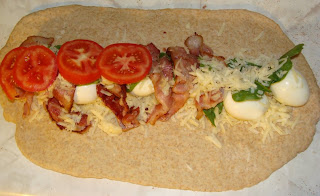
Stuffed bread before cooking
Cooked tomatoes are only popular with the grown-ups, and child #2 doesn't like bacon, but everyone will eat eggs, cheese and baby spinach, so I distributed the filling accordingly along the length of the rolled-out bread dough. Jamie formed his loaf into a ring, but that's too much effort for me, so mine was more the shape of a slug by the time it was cooked:

Cooked stuffed bread
Despite its rustic appearance, this is a meal that everyone will eat and enjoy, and nowadays when I say I'm doing 'the Jamie Oliver thing' for tea the reaction is one of delight rather than revulsion.

Sliced stuffed bread

23 June 2008

Day's eyes

Two beautiful daisies snapped on my walk up to the hayfield today. This one is a native, Robin's Plantain (Erigion pulchellus):

Robin's Plantain
While this one is a European interloper, the Ox-eye Daisy (Leucanthemum vulgare):

Ox-eye daisy
Up at the hayfield it was the usual story: impressive rain-bearing clouds forming to the north of us, while we bask in warm sunshine. Nice for holiday-makers but not so good for the farmers and vegetable growers in this area.

Thunder-head cloud over the hayfield

A bit hot for dogs, too:

Toby panting in the shade of a tree

22 June 2008

Much Mulching in the Barnyard

The time spent hoeing and hand-weeding the vegetable plots was beginning to get to me. I'd read about using mulches to suppress weeds and conserve moisture in Thalassa Cruso's wonderful book, Making Vegetables Grow, which was the first book about gardening in North America that I read, back in the winter. The technique is also being used at the farm north of Toronto that is described in the Tiny Farm Blog, which I started to follow recently. I liked the idea but wasn't sure that I'd have enough mulching material to make it work. Then Mike got a grass-collecting attachment to pull along behind the tractor and all the pieces were in place.

I only had to wait for suitable weather conditions: a decent soaking of rain so that the soil was wet when I put the mulch down. It has been very dry here this month: although much of eastern Canada has seen significant rainfall in the form of thunderstorms, our small corner has been its usual droughty self. We've had only 0.66 inches/18.8mm of rain in June so far.

Cauliflower and broccoli bed with grass mulch
Last night we got an hour of steady rain which at last provided a suitable mulching milieu. The morning was cloudy and coolish: perfect for working outside. I emptied out our first ever load of compost from one of the bins while Mike rounded up the grass clippings and delivered them to the vegetable garden. The compost went around the Amish Paste tomatoes and was topped off with a layer of grass, which was also spread around the peppers, aubergines/eggplants and Riesentraube tomatoes in the same bed. Then I went on to mulch the two brassica beds with grass as well. It was quite time-consuming work and the backs of my thighs are protesting somewhat, but I hope it will save more effort (and maybe water) in the weeks to come.

I don't remember reading much about mulching vegetables like this in the UK (with the exception of straw around strawberries), but then I suspect that the mulch would make a great breeding ground for slugs and snails in a wetter climate than this one, so maybe it wouldn't be such a good scheme over there.

20 June 2008

Tag, you're it

I've been tagged twice now, once by Titania from Queensland, at Yesterday, Today and Tomorrow in my Garden and once by Daphne at Daphne's Dandelions, who's based in Massachusetts. It's a kind of chain-letter thing where the idea is to post six random things about yourself then tag six other bloggers. So here are the six random things:
  1. I once had to knock on the door of Chelmsford Prison in order to get my bicycle back.

  2. I emigrated to Canada from England a year ago this week. It was the biggest decision I've made, but also the best.

  3. Cover of 'Charmed Life' from LibraryThing
  4. Up to the age of nine I would read no books other than Enid Blyton's. Diana Wynne Jones's Charmed Life was the magic read that broke that particular habit.

  5. I had to pay a fine for cycling in a pedestrian zone in Chelmsford (this was unrelated to the Chelmsford prison incident described above!). The policeman who charged me phoned me up later to see if I was OK (is this normal police behaviour?).

  6. I fell in love with archives at the age of 19, while reading a 500-year-old will. I've been 'sniffing the dust' (according to my husband) ever since.

  7. My mother died six years ago after a long fight against the primary-progressive form of multiple sclerosis. I miss her and think of her every day and am constantly sorry that my kids never got to know her properly.
This particular game of tag has been going around for a while and I think all the bloggers I might have listed have already been linked to by somebody else, so I'll leave it there (I've always been rubbish at tag - oops that's seven random things now!).

19 June 2008

Cabbage fights

In England they are known as Cabbage Whites: here they are called Cabbage Butterflies, but their effects are the same. Not all the brassicas have been nobbled - here's a healthy one:

Healthy brassica plant

But this one was less lucky. The little culprits are perfectly camouflaged, but just visible against the veins of the leaves on the left.

Brassica plant being eaten by caterpillars

So now picking caterpillars off my brassica plants has been added to my nightly weeding duties.

The narrator of the 'Dig for Victory' film I mentioned on Tuesday blithely assured his audience that a 10 [square] rod allotment (an area of roughly 100 by 30 feet) would take only one or two hours a week to maintain. The space I've got dedicated to vegetables here is probably roughly equal to a UK allotment and there is simply no way I could keep the weeds under control (let alone the caterpillars) in just two hours a week. Maybe the Ministry of Information wonks were worried that if they were honest about it, no one would take up the challenge of growing their own veg. Or maybe the weeds here are just more beefy and prolific than UK ones. Yes, that'll be it. I find myself muttering "Two hours a week ... TWO HOURS A WEEK!" as I toil away every evening.

17 June 2008

Three sisters not playing nicely

 Corn, bean and squash seedlingsIt's always the same with three - one of them always gets left out or doesn't want to join in properly. With my Mohawk 'Three Sisters' bed it's the corn that isn't co-operating. A few of them have come up, but the majority haven't (I'd sown two separate lots), so I had to re-sow them again on Sunday night.

The runner beans (Wisley Magic) and squash (various varieties - Winter Luxury Pie Pumpkin, Small Wonder (spaghetti squash), small mixed ornamental gourds) germinated almost instantly, but the sweetcorn (Bon Appétit) doesn't want to play. Only five have come up so far, and as they are supposed to be forming the framework for the beans to climb, this is not much use. I tried soaking the kernels in water for an hour or two this time, so maybe that will help. Otherwise I'll have to put up some bean poles, which won't be the end of the world - just a bit irritating.

The Three Sisters feature in the Mohawks' creation story. There's a version of this, as told by Anataras (Al Brant), available from the old Tyendinaga Mohawk Territory site. It took Anataras nine hours to tell this story in the classes I attended earlier this year - so it is quite long and involved!

16 June 2008

Whitetail, Dasher and Skimmer

No, not some of Santa's reindeer, but the dragonflies gracing our pond today. Couldn't resist posting yet more dragonfly pictures (sorry).

Common Whitetail (this is the one I was trying to snap on Friday):
Common Whitetail dragonfly

Blue Dasher:
Blue Dasher dragonfly

Twelve-spotted Skimmer. This one chose the same spot to pose for the camera as the yet-to-be-identified black dragonfly I photographed on Friday.
Twelve-spotted Skimmer dragonfly

These were identified with the aid of the Guides-on-Demand Common Toronto Arthropods site.

Women and potatoes

... have a special relationship, according to the United Nations anyway. 2008 is the UN's International Year of the Potato and they have produced a slightly old-fashioned-seeming video promoting its objectives, with some interesting potato-related facts:


I think it's the cut-glass accent of the narrator that gives the film its archaic quality: a bit like a World War II Ministry of Information bulletin. If you compare this movie with the Ministry's original Dig for Victory film, the resemblance is uncanny! Synchronised digging features in both films, too.

Potato plants, 16 June 2008I'm delighted to discover that my very first year of growing potatoes has coincided with the International Year of the thing.

13 June 2008

Damsels, Dragons, Nelson and Napoleon

 Damselfly with green body and blue end of tail

The photo above shows (if you look closely!) a damselfly on the grass above the surface of the pond, with three tadpoles lurking under the water, two of which have now got legs and spots. Both ponds are busy now with damson- and dragonflies - here is a photo of a dragonfly which was happy to pose for me:

Black dragonfly with yellow spot

There was a more interesting blue-coloured one with stripy wings flying to and fro which I could only get this blurry shot of:

Blue dragonfly, flying

I can see how people get enthusiastic about these creatures - they're really beautiful. They have wonderful names too: Turquoise-tipped Darner, Black-shouldered Spinyleg, Orange Shadowdragon and Glistening Demoiselle, for example. Although the latter really belongs in the Moulin Rouge, I think.

The difference between a damselfly and a dragonfly is (I've just discovered) in the way they hold their wings when they're resting. Which immediately brought to my mind the distinction between Nelson and Napoleon, as described in W. C. Sellar and R. J. Yeatman's 1066 and All That (the best history book ever written):

Napoleon ought never to be confused with Nelson, in spite of their hats being so alike; they can most easily be distinguished from one another by the fact that Nelson always stood with his arm like this, while Napoleon always stood with his arms like that.

12 June 2008

Herbs for winter

 Chopped coriander/cilantro ready for freezing

The coriander/cilantro plants in the front garden beds were looking ready to run to seed this morning, so I trimmed them back and chopped up the trimmings to freeze for use when fresh herbs will be unavailable or expensive. I love carrot and coriander soup, but don't really want it when it's hot outside. In the winter these cubes of herbs will be handy for dishes like that.

Frozen coriander cubes

My daughter hates coriander, which I had put down to her usual faddy eating habits, but a great article by Sona Pai on the Culinate website called 'Why is cilantro so polarizing?' explains that there may be a genetic basis for this herb's love-it or hate-it reputation. She also mentions that it contains an active ingredient that battles salmonella, so maybe fast-food outlets in North America should be adding cilantro to their burgers instead of taking out the tomato.