27 April 2009

Forest-floor flowers

It was one of those strange late-April days when a slow spring suddenly plunges into full summer. We had to wind up the greenhouse walls a bit, to bring the temperature down, as it was hitting 32°C (90°F) in there at midday. The children were off school for the day, so in the afternoon we took them and the dog on an excursion to the Macaulay Mountain conservation area, just outside Picton. There are trails through a steep, densely-wooded hillside (although they aren't terribly well signed and we managed to get lost towards the end!). There weren't many leaves out yet, as you can see in this photo of a Trout lily (Erythronium americanum): There were quite a few Trout lilies and a number of flowers that I confidently told everyone else were anemones: It was only when I got home and started looking them up that I realised that these little flowers are called hepaticas (Hepatica americana). Then I discovered that there are botanists who think that hepaticas should really be reclassified as anemones. So perhaps it doesn't matter too much what they're called. They were very beautiful, either way!

25 April 2009

So, what's at the bottom of YOUR compost pile?

I was diligently turning over the giant compost heap I made last October. It doesn't look much like compost yet, to be frank, but it began to look a bit more like soil near the bottom. I started putting some of this compost on a nearby bed (earmarked for corn this year). Then, as I pulled a forkful of compost away, the air was suddenly filled with piercing squeals and a small nest fell away from the bottom of the fork, tumbling these little beasts out onto the ground. They were not at all happy about being disturbed, I can tell you. I wasn't very happy myself, come to that.


I felt instantly terrible - a mole-molester - but also fascinated at seeing these tiny creatures. I ran off to get a couple of trowels so that I could move the moles without making them smell of human (although my hands were fairly comprehensively covered in compost by this time, so that might not have been a big problem). I also got the camera (because otherwise you wouldn't believe me, right?). I carefully lifted the nest (which still had a few moles inside it - you can see it (and a mole's foot) in the bottom right of the photo above) back into the hole it had come out of, then scooped up the four 'loose' moles and returned them to their siblings. They stopped squealing once they were back in the nest.


Then I re-packed some soil around the nest and covered it over with a handy piece of wood. I sincerely hope that the mother mole will come and rescue her brood and take them to a safer spot. Their eyes aren't open yet, but they're about half the size of an adult so I'm guessing that they're nearly two weeks old (based on the Wikipedia information on Star-nosed moles). I hope they make it to adulthood - sorry for disturbing you, little moles.

24 April 2009

Dewfrost

The slightest of ground frosts this morning - I could almost see the frost turning back to dew as I took these early-morning photos.


23 April 2009

Springing into life

Lots of things are bursting into growth this week. In the orchard there are buds on every tree. The Meteor cherry looks as though it will be the first to blossom, but the apples won't be far behind:Apple bud
In the tyre garden, the asparagus has finally begun to make an appearance:


and next door to the asparagus, the rhubarb leaves are unfurling.


The gutter-grown peas have done so well that I transplanted them into the garden last night. The germination of the Lincoln peas was more patchy than the Oregon Sugar Pod II snow peas/mangetout, so I've sown more peas in amongst the Lincolns. The picture is of the more impressive row of snow peas.


I'm using some of the space in the greenhouse raised beds as nursery beds for the brassicas. Don't these baby red cabbages look gorgeous? Like tiny green butterflies, I think.


There was a very loud bird up at the pond this evening. I couldn't see it, but its song was quite distinctive, so I'm hoping someone will be able to identify it for me. Have a listen:


And on the subject of birds, I ordered my first set of chicks yesterday. I'm going to start of with a set of a dozen Buff Orpington hens from local specialists Performance Poultry. We'll be collecting them in six weeks or so. Really looking forward to this new venture!

19 April 2009

Key lime pie

I'd heard of Key lime pie a long time before I heard about Key limes. For a long time I had dismissed it as something I'd want to make purely (and utterly unfairly) on the basis that it sounded like Mississippi Mud Pie, which I think of as an impossibly sweet dessert. Although it does contain condensed milk and is topped with meringue, Key lime pie is closer in taste to a lemon meringue pie and the tartness of the limes makes it more 'grown-up' than the Mississippi offering. It is also similar to the Hamlyn All Colour Cookbook's chilled lemon flan that my mother used to make (but which didn't have the meringue topping).


Key limes are much smaller than regular limes. My recipe declared that they are sweeter than ordinary limes, while Wikipedia says that they are more tart. So I'm not sure which is right. They're quite fiddly to juice as they are so small - my usual juicing device was too broad to fit inside the tiny fruit, so we had to use a wooden juice reamer instead.

I always use digestive biscuits for the bases of pies like this, but the recipe calls for Graham crackers. I don't know if they'd be better or worse - will have to try Graham crackers one day and see. I don't add any sugar to the biscuit base, as I think the digestives are sweet enough. The recipe suggests whipped cream on top of the pie, but as meringue is more authentic (and there are egg whites left over from the filling), I make the meringue version:


My mother-in-law was helping me and mentioned that her cookery teacher told the class that they should be able to hold the bowl of meringue mixture upside-down over their heads when it got to the required stiffness. That seemed a bit cruel to me - I wonder how many girls ended up with a meringue shampoo after trying this trick!

15 April 2009

Onions, Spring

This is the long bed that was covered in snow last week (looking from south to north this time, in case you're getting a bit bored of the same view). The over-wintered garlic is closest to the camera, still under its mulch of hay, followed by the Egyptian walking onions and then about ten rows of the onions I sowed indoors in January. These were transplanted on Sunday. I think there are about 100 of them - Early Yellow Globe and Sweet Utah (a Spanish onion).

In the distance you can see some slightly wobbly pea supports and two white stripes which are the strips of horticultural fleece I've put down to protect the carrot seeds. It has taken me until this year to realise that these strips are the 'floating row covers' I've seen mentioned on North American blogs. I don't know why, but somehow I imagined that those were something rather more sophisticated, like a cloche, perhaps. There are parsnip seeds immediately behind the onions, meaning that there is now only a small gap in this bed without seeds or transplants in it (an area of about 16 square feet). I'll be filling that with the peas from the greenhouse and successional sowings of carrot and beetroot seeds.

I didn't have this bed last April and was getting very frustrated at being unable to sow any seeds in the much damper, colder, lower vegetable garden (which is only a few feet away from this bed). It's amazing the difference a gentle slope makes at this time of year.

And in the border close to the front of the house the miniature daffodils have finally opened up:
I couldn't resist stopping to take this picture of a young calf and its mother on my way to Deseronto today. It really feels like Spring now.

14 April 2009

Christmas Tree?


Well, maybe in 2020 it will be. A conversation about artificial versus real Christmas trees last December over on Poor Richard's Almanac prompted me into action. I've got the space to grow my own trees, after all and I hope I'll have the time! So I ordered a batch of Balsam Fir seeds from a website called TreeHelp (which is based in the US but also has a Toronto shipping centre for Canadian customers).

The seeds needed to be soaked in water for 24 hours and then cold-stratified (i.e. kept in damp compost in the fridge) for 30 days. I put them out in the greenhouse after that to take their chances. I figured that the fluctuations of temperature in there wouldn't be too dissimilar to what the seeds would experience naturally on the floor of a forest in the Spring.

For many weeks we've been peering into the tray of increasingly-green-looking compost and wondering whether anything was actually going to happen in there. Today our patience was rewarded when I found not one, but TWO little shoots. At least, I'm hoping that they're balsam fir seedlings, rather than random weeds that have found their way into the container. At $6 for 40 seeds, even if only one of these makes it to adulthood, it will still be quite a lot cheaper than buying a tree from elsewhere. This is the first time I've ever grown a tree from seed - it's exciting!

13 April 2009

Gutter press

The peas in the old eavestroughs are coming up nicely now:


The second raised bed is full of soil now (which is great as the first one is fully planted-up) and I got the kids to tamp it down as though they were treading grapes (one day, maybe that might happen too!):

10 April 2009

A family affair

After recent frankly poor performances by the weather, we've been treated to some Good Friday sunshine today. I decided to risk sowing some seeds in one of the long vegetable beds. In went peas, carrots, beetroot, pickling onions and broad beans. Child #2 helped me with the larger seeds. Here he is putting in the broad beans:
At one point he said "I didn't know gardening could be this much fun!". It would have been hard for him to find better words with which to swell my heart with motherly love.

As we worked, we were treated to periodic fly-pasts of huge groups (skeins, I suppose I should say) of Canada geese.


The photo doesn't do justice to the experience, as the noise these birds make as they go over is amazing. You can hear them coming a long time before they are visible in the sky. If you turn the sound up loud and play the video below, you will get some of the effect. With a little of one of our neighbours' chainsaws, too, for that authentic Canadian flavour.


Mike was bringing down some of the big logs he'd cut from fallen ash trees in the last few weeks. His mum decided that the log splitter looked like fun, so got going on getting the biggest ones split up. After doing about 20 she was very tired, but felt that she'd earned her lunch (obviously I wouldn't have let her have any if she'd only managed 19!).

07 April 2009

Bottom-heat

I had a bit of a crisis in the tomato-seed-starting department, when I realised that the lovely new seed trays/flats that I'd bought here in Canada would not fit inside my purchased-in-England electric propagator. Which I had to buy a voltage transformer to get to work here. Is everything is bigger here (except for voltage), or is it that everything is smaller in England? I noticed that kitchen rolls in England looked tiny on my recent trip back.

Now that I'm aware of this seed-tray disparity, I'm using my smaller, English, trays for the seeds that need that extra bit of help from the propagator to get started. However, my large tray of mixed tomato seeds (seven different varieties!) had already been sown before I realised my problem.

Now you may have noticed from my earlier post today that we're back in winter at the moment. Consequently, we had lit the woodburning stove in the kitchen. Which has a large flat area on the top of it. I had a conversation with my aunt this afternoon in which the need for 'bottom-heat' for tomato seeds was mentioned. Later on it occurred to me that today I might be able to provide those seeds with the warmth that they really need.

Now obviously, putting the plastic seed tray directly on to a stove that is capable of boiling a kettle would be foolish, so I experimented with kitchen equipment until I came up with an arrangement which seemed to provide a reasonable level of warmth without creating a melting mess. At this point, the fire in the stove is not being added to, so the whole affair will be gradually cooling over the next few hours.


I will report back on whether this unorthodox arrangement has the desired effect.

Four seasons in one week

In the first week of April we've had 82mm (over three inches) of rain. Which is more than we had in the whole month of April last year. On Sunday the weather gave us a reminder that it is Spring and I was able to get out into the vegetable garden and fork over the two long beds in the 'upper' vegetable garden. They were remarkably dry and workable, despite the absolute soaking they'd had in the previous two days (though the beds next to the greenhouse were still looking more like ponds).
Then this morning we woke up to an inch of snow on the ground and temperatures of -4°C (24°F). The long bed pictured above now looks like this:


The temperature in the greenhouse managed to stay above freezing, although it's a bit dark in there with all the snow on the roof.
The sun is beginning to show itself now, so I don't think this snow will stay around for long.

02 April 2009

Spring greens


You have to look quite hard to see them, but this picture shows my first entirely greenhouse-grown seedlings. There are lettuces at the back and on the right of the shot, with some small spinach plants towards the bottom left. These were sown about four weeks ago in seed trays in the greenhouse and were just big enough to transplant into one of the raised beds today. Very proud of these little specks of green!

Next to them I've sown some land cress (Barbarea verna) seeds and I've also planted a couple of last year's leftover Netted Gem potatoes, in hopes of getting an early crop of those. My main seed potato order will arrive in two weeks from Alberta.

Also in the greenhouse are some of the seedlings I sowed in the warmth of the house earlier in the year, including these onions (Early Yellow Globe) which are looking happier now that they're getting light from all directions.

The other day I re-sowed the peas, as the first batch had vanished completely from the eavestroughs/gutters. This time I balanced the troughs over a corner of one of the raised beds (instead of leaving them on the floor). The peas are still in situ and are now showing signs of sprouting. I think those in the first sowing must have been stolen by mice.

Outside, the garlic is looking better than it did when the snow first melted and the Egyptian walking onions that a neighbour gave me are poking up through the soil, too. I hadn't heard of these before, but they make new bulbs from the top of the plant, which, when they get big enough, will bend the stem down to the ground, setting down the bulbs to grow into new plants. After last year's complete failure of the onion crop, it looks like we will have plenty for 2009.

We also got around to planting the White Birch tree (Betula papyrifera) that was a gift from the organisers of the Green Homes Tour on Sunday. The hole we dug filled up with water quite quickly, so I was relieved to read that this native variety of birch doesn't mind growing in wet meadows!

29 March 2009

Green Homes Tour

We were invited to take part in the County Sustainability Group's Green Homes Tour this year, which forms part of the Quinte Sustainable Living Symposium event this weekend. Three bus parties turned up today (in wet and miserable weather, unfortunately) to get a tour of the solar hot water and geothermal systems in our basement, followed by a look at the greenhouse and at the solar panel set-up in the barn.

It was fantastic to meet so many people with similar interests to ours and Mike did a great job of transmitting his enthusiasm for the green energy projects that we've been undertaking over the last two years. There were a lot of pertinent questions and some good ideas for making the best use of the greenhouse and barns.

One thing that came up which we hadn't heard about before was a concern about using the rainwater from the house roof as drinking water, as the roof has asphalt shingles on it. People in two different groups mentioned that the asphalt can leach out unpleasant chemicals (including oestrogen-like ones) into the water. We hadn't come across this potential problem, so immediately turned to the Internet for answers when the last bus had gone. It turns out that the best way of ensuring that oestrogens are removed from water is to use a reverse osmosis system. Which is what we have, so that's quite a relief!

27 March 2009

Filling raised beds

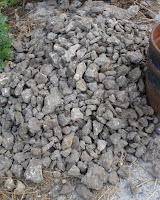
In wet weather, the greenhouse raised beds sit in a puddle of water. To make sure that drainage in the beds wouldn't be a problem I thought it might be a good idea to put sand in the bottom of them. We still had a fairly large heap of sand left behind after the channel from the barn to the house was dug for the backup-power supply, so we didn't need to buy any. Thinking of the way you are supposed to put crocks into containers, I also decided to recycle the large pile of stones that I extracted from the vegetable garden in our first summer here. The pile didn't look that big, but became six (very heavy) barrow-loads.

After tipping in the stones and three tractor-loads of sand the beds had about an inch of material in the base:

Mike has been digging another channel for the stream on the western side of the property, which has given us some topsoil. Here he is with the front-loader of the tractor full of soil for the first bed:

I don't think he had enough opportunity to make mud-pies as a child. Here's a close-up of the contents:

After tipping in six loads, the first bed is now about half-full. The tractor had churned up the path so much that making any more trips seemed unwise today. We've left everything to dry out a bit before doing a bit more, perhaps tomorrow.

While I was away the spinach, lettuce and leeks I sowed in the greenhouse have germinated, but the peas I carefully sowed in the gutters seem to have vanished altogether. Hm, mice maybe? Will have to re-think and re-sow those.

Indoors I've sown peppers and aubergine seeds into trays in the electric propagator. I wasn't too impressed with the Hungarian Hot Wax chilli peppers last year, so this time I've gone for Cayenne and Tomato peppers. I'm also trying again with the Corno di Toro Rosso sweet peppers, despite a lack of any peppers managing to reach maturity last year. I'm hoping that a slightly drier summer and a better location in the garden (one that won't get waterlogged) will do the trick.

26 March 2009

Spring at Wisley

It has been a bit quiet around this blog because I've been on a longish trip away: first Amsterdam, then London, then Manchester, then Buckinghamshire, then Edinburgh and finally to Kent. All in eleven days, so it has been a hectic rush on occasions.

Last Wednesday was one of the more peaceful days in the mix, when my aunt took me out to the Royal Horticultural Society's gardens at Wisley in Surrey. I'd never been before, so this was a real treat. The daffodils, magnolias, hellebores and camellias were looking lovely in the warmish spring sunshine.


The dogwoods (Cornus sanguinea) were looking striking, too. I thought this one, 'Midwinter Fire', was particularly impressive.


The bursts of colour in the Alpine houses were beautiful.


Next door, in the rock house, the resident cat, Sunny, was having a luxurious bask in the sunshine, while pretending to be a plant.


I've been wanting to visit Wisley for ages, so am really grateful to have had this chance, and on such a beautiful day, too.

15 March 2009

Recht Boomssloot


I have only been in Amsterdam for three hours but have learnt a few things already.
  1. It is very easy to get lost while walking in the city centre
  2. The roads have wonderful names (the title of this post is the name of the street in the photo)
  3. I wouldn't want to be responsible for parallel-parking a car next to one of the waterways

14 March 2009

Trust, identity and paranoia

This is a bit off-topic, but I had an email this week from a researcher at Washington University in St. Louis. It read like this:
This is an invitation to participate in an online research study being conducted by Mr. Tal Yarkoni under the supervision of Dr. Simine Vazire at Washington University in St. Louis. The study investigates the relation between people's personality and the content and style of their writing, and has been approved by the Washington University Human Research Protection Office.

The study consists of a single personality questionnaire assessing your personality and background, as well as information about your blog (if you have one). You can choose to participate in either a short or a long version of the study, so your participation can take as little as 10 minutes or as long as 30-40 minutes.
The email address given in the text of the message was a Washington University one, but the email itself came from a gmail.com address. The website with the questionnaire wasn't an official Washington University one and, although the text on the questionnaire looked very legit, I wasn't entirely happy about taking part in the experiment, although it did sound interesting. I did a bit of Googling and found that there certainly was a real researcher by this name, so I sent an email to his 'official' email address, hoping to discover whether Tal was really behind this site and suggesting that the email was likely to put some people off taking part. Searching for the text of the email suggests that it has put off at least one blogger.

Anyway, the upshot is that I had an immediate reply from Tal, explaining that he used Gmail to send out the bulk emails and that Gmail would not allow anything other than a Gmail address to be used for this. He couldn't use a university server for the questionnaire because he needed particular software tools which weren't available on them. So if you're a blogger who has received this message, I feel honour-bound to let you know that it isn't some sort of confidence trick, but a genuine experiment. Tal told me that he's had a better response rate than he was expecting, so clearly not everyone is as paranoid as I am!

11 March 2009

Spot the garlic

The garlic I planted in October is just visible again against its mulch of hay, now that the snow has melted. The shoots look a bit sad and sorry for themselves at the moment, but I hope they'll perk up a bit as the weather gets warmer.

09 March 2009

Ice on the line

They were right about the freezing rain. Don't think I'd want to be hanging my laundry on the line today.