


 The garlic I planted in October is just visible again against its mulch of hay, now that the snow has melted. The shoots look a bit sad and sorry for themselves at the moment, but I hope they'll perk up a bit as the weather gets warmer.
11 March 2009
Spot the garlic
The garlic I planted in October is just visible again against its mulch of hay, now that the snow has melted. The shoots look a bit sad and sorry for themselves at the moment, but I hope they'll perk up a bit as the weather gets warmer.

09 March 2009
Ice on the line
 They were right about the freezing rain. Don't think I'd want to be hanging my laundry on the line today.
08 March 2009
Brief glimpse of Spring
 Hung the washing on the line for the first time this year and then spent a couple of hours this afternoon in the garden and greenhouse. I cleared up the remains of the cabbages that I had failed to harvest before the frosts arrived last year. I also sowed some more lettuce and some leek and spinach seeds into trays in the greenhouse. Mike added a few more scoopfuls of sand to the wettest of the beds in the lower vegetable garden, which I raked into the soil. Or into small ponds, in some cases. Mike also dug another channel to divert some of the stream water away from the barn, which might help to dry the barnyard up a bit more quickly.
I've read about using guttering (eavestrough) to start off peas, so thought I'd have a go at that. In fact the gardener Sarah Raven recommends this for a variety of different vegetables in an article I found online just now. Including parsnips, which might be worth a go. I've never tried doing this before, but as our soil is so cold and damp at the moment (and as I now have a greenhouse to shelter them in!), I thought it was worth a try.
The only time I've seen people doing this, they've been using the semi-circular sort of plastic guttering that you get in the UK. All I had to hand was some old alumin(i)um eavestrough that must have fallen off the side of the small barn at some point. It's square rather than semi-circular, but I'm assuming that it will work just fine. It was quite long, so I got Mike to cut it into two pieces for me, then filled it with potting soil/compost. I've sown Oregon Sugar Snap II in the smaller length and Lincoln peas in the longer one.

Tonight we've got freezing rain forecast, so the fleeting look at Spring won't last long, but it was enough to fill me with enthusiasm for the growing year ahead. Yesterday was so hectic with the book launch we held at the library in Deseronto, that it was lovely today to reconnect with the garden. I'm even pleased to see that my fingernails have regained their trademark growing-season line of muck!
01 March 2009
Daffodils from Canada for St. David
 Impressed, huh? Yes, beautiful daffodils flowering in this Canadian garden just in time for St. David's Day. Not something you see in Ontario very often.
Well, OK. I cheated. That's how my daffodils looked last year on April the 19th. So a little way to go before I'll see them flowering again. On the plus side, a thaw at the end of last week has melted enough snow for me to begin to see some signs of life. Here are the daffodils as they look today:

And I do believe those are small buds of growth on one of the rhubarb plants:

Even the spinach that was sown in September looks as though it might not be completely past it:

It's so lovely to be able to see the soil and the beginnings of new growth again. Even more so this year, as many of the plants are ones that I've set there. Last spring was our first in this house and I was waiting to see what would come up. This year I know what's in the garden and have put a lot of it there myself, so it feels different. Perhaps a little like the difference between a music teacher watching an unknown musician perform and watching one of their own pupils do so.
24 February 2009
Depth of winter
The days are getting longer but it's still really cold (-10°C right now). The wind has been particularly nasty on occasion. This photo is an attempt to capture the thickness of the layers of snow and ice that have built up next to the stream. Precious few signs of spring out there.

Inside I have got some signs of new life with the lettuce mix I sowed in January. They've been growing away well on the living room window sill. I've been putting them out on the veranda on the few days where the temperature has been above freezing. I thought I'd killed them the other day as they had become rather wilted by the afternoon, but was relieved to see this morning that they've bounced back to health again. Some of these will be big enough to eat, soon.


Inside I have got some signs of new life with the lettuce mix I sowed in January. They've been growing away well on the living room window sill. I've been putting them out on the veranda on the few days where the temperature has been above freezing. I thought I'd killed them the other day as they had become rather wilted by the afternoon, but was relieved to see this morning that they've bounced back to health again. Some of these will be big enough to eat, soon.

15 February 2009
Seville oranges and cedar planks
After making marmalade for the first time last year, I was looking forward to doing so again. I keep seeing other bloggers mention theirs and have been looking out for Seville oranges every time I go shopping. Until this weekend: nothing. I was beginning to get twitchy and irritable about the lack of marmalade-fodder. We shopped at the A&P in Belleville yesterday and they had about 12 very sad Seville oranges. I asked if they had any more and was informed that "That's all we've got and there won't be any more". I finished my shop (a very minimal one because by now I was feeling super-grumpy) and we trekked down to the Dewe's store and, joy of joys, they had a large display of lovely-looking Seville oranges. I bought a couple of kilos and left, very happy.
Last year I used a Delia Smith recipe, which made great marmalade but which took a looooong time. I liked the method, which involved pre-cooking the fruit, so looked around for another similar recipe. I found one which had been put online by chef Anna Colquoun. I hadn't heard of her before, but love this quotation from an interview with her on the eat the right stuff blog (which doesn't seem to like CAPITAL LETTERS much):

I had about 4½ pounds of fruit, so had to multiply everything in the recipe by 1½. The simmering-the-fruit phase takes an hour, then the oranges are cut open and the pulp and pips put into one bowl and the peel into another. Here is my first attempt at a video cookery demo (so be gentle in your criticisms please - I know it isn't very enthralling - and I think I sound horribly like Delia Smith!). This is to demonstrate step three in the recipe above - the way that the oranges look after they've been simmered for an hour.
 While it's boiling the marmalade fills the house with a wonderful syrupy citrus smell.
The final boiling phase took about an hour, but might have been quicker if I'd let the marmalade boil faster (I'm a bit timid about leaving pans of boiling syrup unattended). The next video clip shows how it looks at the end of the boiling phase (and how to see whether it's reached setting point):
If you've ever wondered what the recipe books mean by the marmalade wrinkling on a saucer, here's a demonstration:
The finished product looks fine - just as dark and chunky as last year's, but with a shorter cooking time, which is what I wanted. It made eight one-pound jars, which is about four fewer than the recipe suggests I should have got.
I have since been wondering whether it is all worth it, given the food miles involved in shipping the oranges from Spain to Canada (and being aware that several jars will be travelling back to England with my mother-in-law after her next visit!). But I love making (and eating) marmalade so much that I would be sorry not to, even if it is a thoroughly environmentally-unsound rigmarole. [POSTSCRIPT: It turns out that our Seville oranges are actually from the USA, so I'm less worried about this now.]
My other Valentine's Day present was a fine trailer-load of cedar planks and posts, which were destined to become the raised beds in the greenhouse. We had thought we'd be able to use pressure-treated timber, but I remembered some question about arsenic being used in that process (rendering it not safe for use around food crops) and Mike looked it up to check. Well, the good news was that arsenic hasn't been used in the pressure-treating process since 2003, but the bad news was that if you want to grow food that will be certified organic, it might not be acceptable. Using cedar planks was the other option. The wood should last for 20 years - but was twice the cost of the pressure-treated alternative. So I really do need to sell some of the food we'll be growing in these beds in order to justify the expenditure. Which means jumping through the organically-certified hoops at some point. Oh joy.
Building them was fun though. It was still below freezing outside, but in the greenhouse it was pleasantly warm. We constructed three beds in a couple of hours and they look fantastic. Now we've just got to work out how to fill them with a suitably organic growing medium. I had been thinking of getting some spent mushroom compost from the local mushroom farm, but a bit of reading around the topic suggests that it will be full of chemicals, so not a good plan. Looks like we'll be digging soil from other parts of the farm and combining it with home-made compost to start with. But 270 cubic feet of material is quite a lot to find...

Last year I used a Delia Smith recipe, which made great marmalade but which took a looooong time. I liked the method, which involved pre-cooking the fruit, so looked around for another similar recipe. I found one which had been put online by chef Anna Colquoun. I hadn't heard of her before, but love this quotation from an interview with her on the eat the right stuff blog (which doesn't seem to like CAPITAL LETTERS much):
americans eat one meal out of five in a car. the western industrialised food system is fast ruining our planet, our social and economic relations, our bodies, our understanding and appreciation of these things, and ultimately our happiness. there are plenty of things wrong with the world, and cooking lovely food isn’t going to lead to world peace, but life for many could be a bit better if more people cared where their food came from and how it was made, had some basic cooking skills so they needn’t rely on processed food, and took time to eat together. plus, cooking is a creative outlet and a hopefully healthy addiction. food can be so delicious and also so bad. it’s more fun to eat the delicious stuff.This is someone I feel I can trust! The marmalade recipe is the one her mother uses, based on one by Katie Stewart in The Times Cookery Book. Phew, that feels like a long and convoluted provenance (here's the recipe: it's a PDF file).

I had about 4½ pounds of fruit, so had to multiply everything in the recipe by 1½. The simmering-the-fruit phase takes an hour, then the oranges are cut open and the pulp and pips put into one bowl and the peel into another. Here is my first attempt at a video cookery demo (so be gentle in your criticisms please - I know it isn't very enthralling - and I think I sound horribly like Delia Smith!). This is to demonstrate step three in the recipe above - the way that the oranges look after they've been simmered for an hour.
 While it's boiling the marmalade fills the house with a wonderful syrupy citrus smell.
The final boiling phase took about an hour, but might have been quicker if I'd let the marmalade boil faster (I'm a bit timid about leaving pans of boiling syrup unattended). The next video clip shows how it looks at the end of the boiling phase (and how to see whether it's reached setting point):
If you've ever wondered what the recipe books mean by the marmalade wrinkling on a saucer, here's a demonstration:
The finished product looks fine - just as dark and chunky as last year's, but with a shorter cooking time, which is what I wanted. It made eight one-pound jars, which is about four fewer than the recipe suggests I should have got.

I have since been wondering whether it is all worth it, given the food miles involved in shipping the oranges from Spain to Canada (and being aware that several jars will be travelling back to England with my mother-in-law after her next visit!). But I love making (and eating) marmalade so much that I would be sorry not to, even if it is a thoroughly environmentally-unsound rigmarole. [POSTSCRIPT: It turns out that our Seville oranges are actually from the USA, so I'm less worried about this now.]
My other Valentine's Day present was a fine trailer-load of cedar planks and posts, which were destined to become the raised beds in the greenhouse. We had thought we'd be able to use pressure-treated timber, but I remembered some question about arsenic being used in that process (rendering it not safe for use around food crops) and Mike looked it up to check. Well, the good news was that arsenic hasn't been used in the pressure-treating process since 2003, but the bad news was that if you want to grow food that will be certified organic, it might not be acceptable. Using cedar planks was the other option. The wood should last for 20 years - but was twice the cost of the pressure-treated alternative. So I really do need to sell some of the food we'll be growing in these beds in order to justify the expenditure. Which means jumping through the organically-certified hoops at some point. Oh joy.
Building them was fun though. It was still below freezing outside, but in the greenhouse it was pleasantly warm. We constructed three beds in a couple of hours and they look fantastic. Now we've just got to work out how to fill them with a suitably organic growing medium. I had been thinking of getting some spent mushroom compost from the local mushroom farm, but a bit of reading around the topic suggests that it will be full of chemicals, so not a good plan. Looks like we'll be digging soil from other parts of the farm and combining it with home-made compost to start with. But 270 cubic feet of material is quite a lot to find...

13 February 2009
I'm really, really not sure about this...
 It's a bit slick up by the barn, where all that water froze overnight. The dog was not impressed.
12 February 2009
Awash
A few days of above-zero temperatures and over an inch of rain have left us swamped with far too much water. Yesterday began rather attractively with layers of mist forming above the snow. I stopped on my way to work in Deseronto to take this picture of the Bay of Quinte from Georges Road. The mist was forming above the ice on the bay as the snow began to melt.

Last night was just plain foggy. We drove back from a meal in Picton through some of the thickest fog I've ever seen. Where there were road markings, it wasn't too bad because you could line up with the white and yellow lines, but on the minor roads it was scary because the edges weren't so obvious. It was particularly frightening coming along Lakeside Drive, as we were all too aware of the proximity of the lake in question!
Today the fog had gone, but water continues to gush down the slope on which our property sits. The 'path' to the barn has been transformed into a fast-flowing stream with treacherous icy sections which is almost impossible to walk along:

The worst part is that the weather is due to turn cold again for the next week, which will turn all of this water into ice and make it even more difficult to walk!
Enough grumbling. Here's a pretty sunset from the other night to change the subject.

07 February 2009
Cold out there - but warm and cosy inside
It's finally started to warm up a bit. The weather station reports that for January we had:
 Mean high: -4.7°C/23.5°F (norm -2°C/28°)
Mean low: -14.3°C/6.3°F (norm -14°C/6.8°F)
Average temperature: -9°C/15.8°F (norm -7°C/19.4°F)
Days with temperatures below -18°C/0°F: 12
Days with temperatures above 0°C/32°F: 5
Highest temperature: 3.3°C/38°F
Lowest temperature: -24.4°C/-12°F
So it has been a couple of degrees colder overall than the long-term average for this area. There certainly wasn't a noticeable thaw this January.
With precious little happening on the gardening front (and beginning to get tired of looking at snow and icicles), I've been interested to follow a gardening meme started by VP on her Veg Plotting blog. VP is asking fellow gardening bloggers to select 3-5 dinner party guests for this evening who have an interest in gardening or nature. There have been some excellent entries (see VP's own selection and the links from that post for other people's).
 I've been having some thought about this and am finding it very difficult, but here are my choices of people I'd like to see around the table at my imaginary dinner party tonight.
Firstly (since an interest in nature as well as gardening is allowed) I think I'd like Sir David Attenborough to come along. I bet he is just full of brilliant stories about plants, animals and people. I so enjoyed her book The Naming of Names, that I'd love to have Anna Pavord as guest number two. I'm sure lots of other British gardeners will choose my third guest, Geoff Hamilton. My parents always watched Gardeners' World on a Friday evening and Geoff presented the show for 17 years until his untimely death in 1996. I wasn't really into gardening in those days, but even I found the parts of the show with Geoff in them interesting and accessible. As an early advocate of organic methods, he had a big impact on UK gardeners.
I would be interested to see how Geoff got on with my fourth guest, Michael Pollan, the hugely influential US writer on food and agriculture. My final guest would be Kate Gardner, resident of Bozeman, Montana, and author of the Manic Gardener blog, which is stuffed full of interesting research on organic gardening and the environment, but which also makes me chuckle on a regular basis. If I had a bigger table there are a number of other bloggers that I'd squeeze in around the corners, too, but VP has limited our guests to just five, so maybe another time...
 Mean high: -4.7°C/23.5°F (norm -2°C/28°)
Mean low: -14.3°C/6.3°F (norm -14°C/6.8°F)
Average temperature: -9°C/15.8°F (norm -7°C/19.4°F)
Days with temperatures below -18°C/0°F: 12
Days with temperatures above 0°C/32°F: 5
Highest temperature: 3.3°C/38°F
Lowest temperature: -24.4°C/-12°F
So it has been a couple of degrees colder overall than the long-term average for this area. There certainly wasn't a noticeable thaw this January.
With precious little happening on the gardening front (and beginning to get tired of looking at snow and icicles), I've been interested to follow a gardening meme started by VP on her Veg Plotting blog. VP is asking fellow gardening bloggers to select 3-5 dinner party guests for this evening who have an interest in gardening or nature. There have been some excellent entries (see VP's own selection and the links from that post for other people's).
I've been having some thought about this and am finding it very difficult, but here are my choices of people I'd like to see around the table at my imaginary dinner party tonight.Firstly (since an interest in nature as well as gardening is allowed) I think I'd like Sir David Attenborough to come along. I bet he is just full of brilliant stories about plants, animals and people. I so enjoyed her book The Naming of Names, that I'd love to have Anna Pavord as guest number two. I'm sure lots of other British gardeners will choose my third guest, Geoff Hamilton. My parents always watched Gardeners' World on a Friday evening and Geoff presented the show for 17 years until his untimely death in 1996. I wasn't really into gardening in those days, but even I found the parts of the show with Geoff in them interesting and accessible. As an early advocate of organic methods, he had a big impact on UK gardeners.
I would be interested to see how Geoff got on with my fourth guest, Michael Pollan, the hugely influential US writer on food and agriculture. My final guest would be Kate Gardner, resident of Bozeman, Montana, and author of the Manic Gardener blog, which is stuffed full of interesting research on organic gardening and the environment, but which also makes me chuckle on a regular basis. If I had a bigger table there are a number of other bloggers that I'd squeeze in around the corners, too, but VP has limited our guests to just five, so maybe another time...
01 February 2009
Having a (snow) ball
 We've had so much snow over the past week. The kids are thoroughly enjoying it: making forts, snow-people and burrows and getting completely caked in it. The demand for hot chocolate is high.

After this family snow battle on Friday, child #2 declared it to have been the best fun he'd ever had (except for our trip to the water park in Montreal last year). That made me smile - you can spend a fortune on electronic gadgets of various kinds, but in a child's mind, it's the time you spend doing fun things together as a family that are the best.

30 January 2009
Do I have to go out?
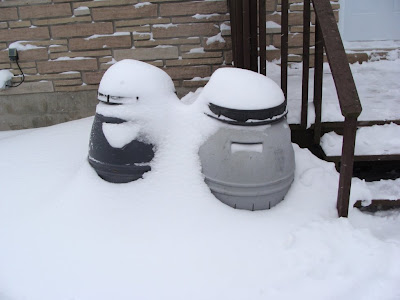
Just taking the green kitchen waste out to the compost bins is a mite challenging when the bins look like this:
The greenhouse is getting a good bit of snowy insulation:
I would hardly venture out at all if it weren't for the dog needing to do what a dog needs to do. It seems to take forever just to put on enough clothes to be able to go out and stay at least mostly warm and dry. Though even the dog didn't waste much time out there yesterday afternoon, when the snow was coming in horizontally and the temperature was -5°C (23°F):

The greenhouse is getting a good bit of snowy insulation:

I would hardly venture out at all if it weren't for the dog needing to do what a dog needs to do. It seems to take forever just to put on enough clothes to be able to go out and stay at least mostly warm and dry. Though even the dog didn't waste much time out there yesterday afternoon, when the snow was coming in horizontally and the temperature was -5°C (23°F):
29 January 2009
Sleeping under newspapers
 Now that the alumin(i)um wiring has all gone, we could finally get round to putting a decent layer of insulation in the attic. I'd say 'loft', but I recently discovered that attic≠loft in Canadian English. Though I'm not entirely clear on the distinction - so any clarification welcome!
We now have a snug 15-inch layer of recycled newsprint above our heads (it has been converted into fluff and treated to make it fire- and pest-resistant, I feel I should point out). This brings the R-value of the attic's insulation up to 50 from its previous level of around 10. Should make it a bit warmer upstairs on these cold winter nights...
26 January 2009
'Photogenic drawings'
Couldn't resist having a bit more of a play with making some high-tech versions of the Fox Talbot photogenic drawings. These are made from some pictures of the few plants that are still visible above the snow: trees, grass and seedheads of asters and Queen Anne's lace.


Black on white
Some lake-effect snow coming down this morning while the sun did its best to reach us. I've always liked the way that falling snow looks black against the sky. Not sure you'll be able to see it in this shot (unless you click on the picture for a closer look).

Thought I'd try turning the image into a negative to see if I could turn the snow white again:

I'm not sure that the snow is any easier to see, but I really like the effect made by the outlines of the trees. It reminds me of the early 'photogenic drawing process' images developed by William Fox Talbot in the 1830s (for an example see the lovely image of fern leaves in an online De Montfort University exhibit about the man). Will have to play with this option some more, I think...
25 January 2009
School lunch snack #3
 Yes!! Have managed to make sweet snacks for every school day in January. Now just have to keep that up for the rest of the year. This week the request was for jam tarts.
I once made jam tarts when I was a first-year student. I had jam and butter but no bread (of the yeast or financial varieties), and a desperate craving for something sweet to eat. Making jam tarts seemed like the obvious solution - even though the hall of residence kitchen only had one of those terrible little Baby Belling ovens. We had had a Christmas party which involved making mince pies, so I did have a bun tin to hand.
Jam tarts have never tasted as good as they did that night.
20 January 2009

Raised beds (be VERY careful!)
Carol at May Dreams Gardens has written a great post on the subject of raised beds. I commented there briefly about my experience, but thought it might be worth blogging about it here, with some pictures to record what happened with mine (as a cautionary tale, too, perhaps).
We had a small easterly-facing back garden in Manchester (about 100 square metres/yards) which was really just a square of lawn with some shrubs around the edges and a small patio area. In 2005 (inspired by two allotment-owning co-workers) I decided to put a raised bed in the lawn near to the house as my first foray into vegetable-growing.
 The frame was made from three eight-foot lengths of pressure-treated decking, screwed to four posts (the posts ended up shorter than they were in this picture). On 16 January 2005 I dug the grass up, put in the frame, added a big bag of compost, put the grass back in (upside down) and covered the whole thing with some heavy black plastic, weighted down, to stop weeds and to kill the grass. At the end of all that the bed looked like this:

Two months later, the covers were off and I was sowing my first vegetables. By the end of May the bed was looking full of green life and I was fully addicted to the process of growing food.
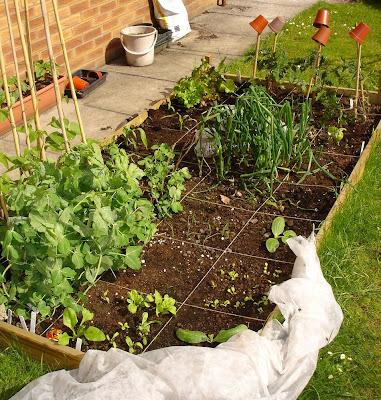
On New Year's Day 2006 the second raised bed was constructed.

This was not followed by a third bed in 2007 - because by then we were busily planning our move to Canada and weren't going to be in that house to gather in the harvest. I still couldn't resist planting seeds in the beds that year, though (more proof of my addiction). And yes, part of the motivation for our emigration was the chance of getting hold of a decent-sized plot of land for growing food without bankrupting ourselves.
 As soon as we saw the new house in April, the potential of the barnyard as a vegetable plot became obvious and this blog records the progress we've made since we moved in here in June 2007. With ten large vegetable plots already established and plans for another one of those and three raised beds in the greenhouse this year, I find it a bit amazing that it was only four years ago that I started all this by digging out one little raised bed.
So, a warning might be in order. If your spouse suggests putting in a raised bed this year ("Just one dear, and it won't take up much space."), there is a danger that you might find yourself leaving your country a few years later to satisfy their insatiable hunger for more land for their crops. Be warned!!
We had a small easterly-facing back garden in Manchester (about 100 square metres/yards) which was really just a square of lawn with some shrubs around the edges and a small patio area. In 2005 (inspired by two allotment-owning co-workers) I decided to put a raised bed in the lawn near to the house as my first foray into vegetable-growing.
 The frame was made from three eight-foot lengths of pressure-treated decking, screwed to four posts (the posts ended up shorter than they were in this picture). On 16 January 2005 I dug the grass up, put in the frame, added a big bag of compost, put the grass back in (upside down) and covered the whole thing with some heavy black plastic, weighted down, to stop weeds and to kill the grass. At the end of all that the bed looked like this:

Two months later, the covers were off and I was sowing my first vegetables. By the end of May the bed was looking full of green life and I was fully addicted to the process of growing food.

On New Year's Day 2006 the second raised bed was constructed.

This was not followed by a third bed in 2007 - because by then we were busily planning our move to Canada and weren't going to be in that house to gather in the harvest. I still couldn't resist planting seeds in the beds that year, though (more proof of my addiction). And yes, part of the motivation for our emigration was the chance of getting hold of a decent-sized plot of land for growing food without bankrupting ourselves.
 As soon as we saw the new house in April, the potential of the barnyard as a vegetable plot became obvious and this blog records the progress we've made since we moved in here in June 2007. With ten large vegetable plots already established and plans for another one of those and three raised beds in the greenhouse this year, I find it a bit amazing that it was only four years ago that I started all this by digging out one little raised bed.
So, a warning might be in order. If your spouse suggests putting in a raised bed this year ("Just one dear, and it won't take up much space."), there is a danger that you might find yourself leaving your country a few years later to satisfy their insatiable hunger for more land for their crops. Be warned!!
19 January 2009
Monochrome

Twenty-four hours of snow have given us a very black-and-white sort of world, even when shooting colour photographs.

The sun did make a weak and watery appearance earlier this morning, but it didn't last for long.

18 January 2009
School lunch snack #2

Well, actually this is week 3 of school, but last week I made rice krispie squares (just melted marshmallows and butter with rice krispies stirred into them), which didn't really merit a post all to themselves. Although I am pleased to report that the children preferred them to the official Rice Krispie equivalent snack that we've bought in the past.
This week's snacks are cinnamon buns.
Ingredients
For the dough
1 pint warm milk (at body temperature)1 tablespoon sugar
1 teaspoon vanilla extract
1 egg
2 teaspoons dried yeast
4-5 cups of flour
1 teaspoon cinnamon
For the filling
1 tablespoon butterCinnamon
Brown sugar
Mix the yeast, sugar and milk together. Stir in the egg and then add the cinnamon enough flour to make a dough that you (or your mixer/breadmaker) can knead. I used about four cups of white bread flour and one cup of wholewheat. Knead it for 5 minutes or so, then roll out the dough into a large rectangle, making sure there's enough flour on the work surface so that the dough won't stick to it later on. Actually, getting the dough into a rectangle isn't possible, but something vaguely resembling a rectangle is fine.
Melt the tablespoon of butter and brush it over the dough. Sprinkle cinnamon and brown sugar over the top of the butter. Here's how mine looked at that point:

Clearly not a rectangle!
Then you need to roll it up from one of the longer sides:

This gives you a long sausage-shape which you then need to slice up. I need 20 buns (one for each child for each meal break: they have two meal breaks a day, which seems odd to me but the school says it works well, so fair enough). To make it easier I cut the dough into four first, then each of the four into five buns. If you're into precision, you could measure them to make sure they're even, but I didn't bother.

Arrange the sliced buns into a greased tray or dish and leave them to rise in a warm room, until they're looking as though they've filled out a bit. This will depend on the temperature, so can take up to an hour. Here are mine before rising:

When you're happy with their size, put them into a pre-heated oven at 400°F/200°C/Gas Mark 6 for about 20-25 minutes. I gave mine a brush of milk and sprinkled them with some white sugar before baking them.
These will keep in an airtight container for the week. I'd put the container in the fridge if the weather was hot and humid. Not that I think that's going to be a problem this week...
Am I going to be able to keep this snack-making activity going into a fourth week of school? Watch this space...
16 January 2009
Making your vegetable patch pay
I'm starting to get excited about this year's vegetables. I already have some onion seeds in trays on the living room window sill and a tray of mixed lettuce seeds next to them. These will be transferred to the greenhouse once it warms up a bit. While browsing around trying to find out exactly how hardy onion seedlings are, Google took me to pages of the Vegetable Growing Handbook: Organic and Traditional Methods by Walter E. Splittstoesser. This book was published in 1990 and looks like an interesting read. For example, he shows a table of value ratings for particular vegetables, based on the space they occupy, their yields and their monetary value, on a scale of one to ten. This was developed by the US National Garden Bureau (no date given) from feedback given by expert home vegetable growers. I've reproduced the table here (click on it for a closer look):
 So, to get the most value from your plot it's best to concentrate on the higher-rated vegetables, particularly if you're short of space. As long as you like them, that is. I also liked the mention of a study in Ohio which was published in the journal Horticultural Science in 1978 by Jim D. Utzinger and H. E. Connolly which calculated that...
 So, to get the most value from your plot it's best to concentrate on the higher-rated vegetables, particularly if you're short of space. As long as you like them, that is. I also liked the mention of a study in Ohio which was published in the journal Horticultural Science in 1978 by Jim D. Utzinger and H. E. Connolly which calculated that...
...a garden of 150 sq ft produced enough vegetables to provide a return for labor of $1.08 per hr; and this value was calculated after all expenses, including depreciation on the garden tools, were deducted. Few leisure-time activities pay you for doing them.I'd love to know what that $1.08 figure would be in today's money. I wonder whether vegetables more expensive, relatively speaking, now, than they were then, for example? Organically-grown ones certainly are.
Subscribe to:
Posts (Atom)