04 September 2016

A severe summer

This was a screenshot from the Weather Network site last month:


It caught my attention, as 'severe' is not usually a word I'd associate with summer weather. But it has turned out to be an apt one for this season.

We are used to dealing with very dry summers, but this has been the worst one since we've been in Canada. At the height of the drought, on August 13th, I forced myself to take photographs of the vegetable garden. With barely enough water for the household, I had not been able to water the garden at all, and the plants were really suffering. In the whole of July we had 23mm of rain and the previous three months were also very dry (April 23mm, May 19mm, June 48mm).

The cabbage patch:


The squash plants:


The row of sunflowers next to the squash:


We got an inch of rain that day, followed by half an inch three days later and that was enough to start the plants growing again. It's still very dry, but the 48mm we received in August has made a huge difference to the garden.

This how the cabbage patch looks now:


And the sunflowers, with the squash behind them, are looking a bit healthier. Two of the squash plants died in the drought, but the others have recovered and I'm now picking patty pan squash. This week I will pick the first of the zucchini/courgettes. The only problem now is that the weeds are also enjoying the rain!


In less happy news, I have to report that my entire flock of chickens (33 birds) were killed by a mink during July and August. I don't know if the dry weather was a contributory factor, but I suspect it might have been. Over the course of three weeks I fought a losing battle with this night-time killer. Every time I thought I'd managed to mink-proof the coop, it found a way through (they only need an inch) and killed one or more chickens. One night it killed eight. On the morning of August 8th I found the last seven chickens dead on the floor.

After eight years of keeping chickens I think I'm going to stop, for a while at least. I am really going to miss them, and their eggs (my birds had produced 15,000 eggs in the time I had them), but right now one less responsibility is probably a good thing. But yes, this summer has been severe indeed.

03 July 2016

Last post [?]

Ten years ago today I published First Post, the very first entry on Cooking in Someone Else's Kitchen. As I explained in my most recent post, life has rather got in the way of my blogging of late, but this anniversary seems a good time to sit down and reflect about the way this emigration journey has gone.

Ten years ago our small family was about to make a leap into the unknown. We had no jobs to come to in Canada and we knew very little about the country. A lot has changed in those years, both here and in the United Kingdom. Mike and I both have permanent full-time jobs in our respective careers, and our kids have grown up into thoughtful young Canadians.

These last weeks I have been watching the news coming out of the UK with rapt interest, as the country dealt with the EU referendum vote and then its aftermath. One of the best things I've seen about the impact of the Brexit vote was by Michael Dougan, an EU law professor from the University of Liverpool, who presented an analysis of the Leave arguments before the vote and then again after the vote's results were known.

I did have a vote in the referendum, and I voted Remain. My motivation was primarily one  of keeping options open for my kids: having an EU passport gave them the opportunity of living and working anywhere in Europe if they wanted to. If the withdrawal from the EU goes ahead, they will only have the option of living and working in Canada and the countries of the UK (and that's assuming that the UK holds together as one nation). Which is still better than only being able to live and work in the UK, of course, but I feel bad for the British youngsters whose futures have been trammelled by those who believed the empty promises of the Leave campaign.

One of the consequences of the result of the vote has been an increase in British people investigating how to move to Canada. It will be interesting to see if this will cause a spike in applications. This is a country that welcomes immigrants, but doesn't actually make it all that easy to become one, so good luck if you are in the UK and thinking of applying!

And speaking of new immigrants, my mother-in-law (and her dog) will soon be joining us from the UK. She arrives at the end of the month and we are busy making space for her and her things (it's amazing how much junk we have accumulated after being in the same house for nine years!). We sponsored her back in 2010, so this moment has been a long time coming. I'm hoping she'll arrive before civil war breaks out in Britain. Just joking! (I think...)

02 May 2016

Still here...

I thought I'd better post an update in case anyone is wondering why I haven't been posting much recently. The main reason is that I'm back working full-time again, for the first time since moving to Canada. Carving out time for gardening is one issue, but finding time for blogging about it is quite another!

I'm working as the archivist for the County of Hastings and the City of Belleville. I took over the job on a temporary contract last July, and was appointed on a permanent basis in March. In the first nine months I had to move the entire archive to a new location, which was quite a challenge but we are now safely in the new building and settling in. I am loving it.

In other news, Mike's mother has finally received permission to move to Canada as a permanent resident. (We got this news the same day I heard about getting the permanent job - a red-letter day!) We first applied for her to come over in April 2010, so it has been a long process, but now we can move ahead at last. The to-do list has grown again, but at least we can now make definite plans for bringing her here and making changes to the house to accommodate her. Exciting times!

25 March 2016

Winter's last blast

 After a mild few weeks, the weather took a turn for the colder this week. Yesterday an ice storm came through and left a fairly thick coating of ice over everything. This morning it warmed up quickly, so the ice began to melt: we could hear it almost exploding off the roof as we woke up.


The chickens' run resembled an ice rink. And it turns out chickens don't like skating, even if they are Canadian.


31 January 2016

Chickens out


Last day of January and a rare sight: the chickens being able to venture outside. For the last two winters they were cooped up for three months in a row. This winter has been much kinder. There are still a few inches of snow on the ground, but today's temperature is due to climb to 6°C/43°F, so I'm thinking by this evening there won't be too much left.

We have yet to have a day this winter where the temperature has gone below -20°C/-4°F, which is fairly unusual, and the average temperature for the month of January is running at -5°C/23°F, where normally it is -7°C/19°F.

The week ahead looks mild, but then there is a return to more normal winter temperature after that. As this week and last week are usually the cold point of the year, I'm certainly not complaining...

16 January 2016

Library trip

I don't let the weather stop me returning my library books...


It turned quite snowy here this week, with about a foot of snow falling on Wednesday night/Thursday morning. Luckily the book drop box has been designed with Canadian weather in mind!

03 January 2016

First and last

...harvest, that is. The first of 2016 and the last of last year's crops, I think.


With winter finally putting in an appearance, and the temperature due to drop drastically tonight, I dug up my remaining swedes/rutabagas and harvested the cabbages, sprouts, purple cauliflower and kale which were still bravely clinging on in my two brassica beds. There were over ten pounds of swedes!

The cabbages were still very small, so I decided to use them up by making kimchi out of them. They're not napa cabbages, which is the usual kimchi one, but I will experiment with what I have, approximately following this recipe, and if it works out, I'll buy the proper cabbage next time I go shopping. I found some baby leeks, carrots and one lone Chioggia beet in the greenhouse, so I've sliced those up and added them to the kimchi mix.


Now I just need to find a way of using up all those swedes...

24 December 2015

Christmas Eve harvest

I know it can't last, but the exceptional weather has continued, with temperatures hitting 15°C/59°F today. I was able to harvest quite a few green things from the garden for our Christmas dinner:

broccoli


kale


small but perfectly formed purple cauliflowers


and both sprouts and Brussels tops


I pulled up a swede/rutabaga, too.

We are promised a storm next week and I'm sure winter proper will be upon us soon, but I am thoroughly enjoying this reprieve, however temporary!

06 December 2015

Bringing the garden indoors

Still mild here (hope writing that doesn't jinx things) - the greenhouse herbs are still going strong. Here's the dill:


The parsley is still going, too. I mentioned the herbs to a colleague who asked if I bring some in for the winter. I don't normally (apart from the rosemary), but this struck me as an excellent idea, so this winter I have done just that, bringing some in from the garden, others from the greenhouse. The cat is having to share her windowsill with rosemary, dill, sage, thyme, oregano, parsley and coriander/cilantro. You can't see it in this photo, but the rosemary is actually flowering at the moment!


There were still some root crops to harvest: I pulled the last of the parsnips, most of the carrots and a couple of parsnips from the greenhouse and dug up a couple of pounds of sunchokes from the garden, as the soil is still soft enough to dig.


I also got a cabbage from the brassica patch, which is still doing well - there will be swedes/rutabagas to pull and more kale there. I think we might even get some Brussels sprouts, although they won't be as big as the ones happening in the UK this year. They even made the front page of the Weather Network's site (I think they are having to drum up stories about sprouts because the weather is being so un-newsworthy here!).


29 November 2015

Winter on the way

November has been so mild, I'm still picking kale from the garden. Which is lucky, because the ones in the greenhouse are being comprehensively nibbled by caterpillars.


This morning was the coldest yet, -8C/17F but gorgeously sparkly. Just a taste of winter.


Or maybe a warning...

18 October 2015

Pre-frost harvest

Yesterday evening I was running round the greenhouse in a variation on Supermarket Sweep, gathering up vegetables that I thought might be damaged beyond edibility by the coming frost.


The frost certainly arrived: touching my marigolds


and my outside vegetables. Not that this kale will mind: there's a fair bit of broccoli, cabbage, sprouts and cabbage still to harvest outside and this level of cold won't do them any harm.


And having done all that harvesting, the plants in the greenhouse survived the frost undamaged, so with any luck there will still be more tomatoes and peppers to gather in the next week or two.

10 October 2015

Thanksgiving harvest


There was a slight frost this morning: not enough to kill anything, or spoil the tomatoes, but enough to turn the roof white and create a crispy feeling underfoot.

The Thanksgiving weekend is upon us, and Child1 has come home from university to share it with us. We've been talking on Skype most days, probably for longer than when we were under the same roof, but it's nice to have everyone under the same roof for a while (even if it is covered with frost).

I did a sweep of the garden and greenhouse to gather up food for the weekend. Pulled a huge cabbage, three pie pumpkins, some tomatoes, eggplants, zucchini and peppers. Bottom left are what I at first thought should be purple cauliflower, but then gradually worked out are in fact purple sprouting broccoli. This is the first year I've successfully grown these. There are some mini purple cauliflower coming too, but the leaves, now I look at them, are different from the broccoli ones.

Plenty to give thanks for, anyway!

27 September 2015

Sun-drying tomatoes


One of the tomato varieties I regularly grow is Principe Borghese (I seem to recall that these were a gift from another garden blogger, some years ago). In one of the descriptions online was a note that it used as a sun-dried tomato in Italy. Ever since I read that I've been thinking I should try this, but haven't got around to it until this year.

My oven has a dehydration setting, which is what I used for my first batch, but it was not very successful: even after 24 hours the tomatoes weren't dry and I wasn't impressed at having to leave the oven on for so long. (I did learn that my oven automatically turns itself off after being on for 12 hours, so that was vaguely interesting.)

So, Plan B. Which involves the sun. Much more satisfactory.

My set-up is about as low-tech as it gets. Small tomatoes, cut in half and arranged on a baking tray in the greenhouse. I've put the tray on top of some small plant pots - thinking this might deter crawling insects - and I have loosely wrapped horticultural fleece over the tray. The fleece allows the sun through, while letting moisture evaporate off. It also stops flying insects landing on the tomatoes.


They've only been out there for eight hours and are already looking drier than the first batch did after 12 hours in the oven.


If this works, it really is ridiculously easy!

06 September 2015

All shapes and sizes

I've got three different eggplant varieties growing this year, and so far I've had one fruit from each, with quite a few more to come if it stays warm for a while.

This one, applegreen, is new to me:


Korean early long:


And my favourite, as far as looks go, rosa bianca:


05 September 2015

Peppers (again!)

The hot weather in the last couple of weeks has really been ripening the peppers. I spent a happy ten minutes this morning, picking them.


I roasted the sweet peppers and then pulled the skins off them, once they'd cooled down a bit.


Then I packed them into a jar and pressure canned them for half an hour. This should preserve them over the winter.


I also tried a new trick with the pressure cooker - using it to cook eggs. Fresh eggs are always a pain to peel, but if you cook them in the pressure cooker, they turn out to be extremely easy. I cooked them at the lower pressure setting for six minutes. I think next time I'll do it for four or five, as the yolks were a bit dry for my taste, but this was definitely an experiment that was worth repeating.


15 August 2015

Pepper pots


The peppers remained green for a long time, but are just starting to ripen. I picked two large flower-pots' worth this morning. The bright red ones in the middle are Cayennes and the ones to the bottom are Hungarian Hot Wax. The dark red peppers were supposed to be California Wonder,  but they look more like the Chocolate pepper I've grown in other years. The pretty yellow ones are Antohi peppers - they have an orange blush to them as they ripen. And the green ones are Tam JalapeƱo peppers, which I have sliced and pickled for winter use, together with the Hot Wax ones. They're nice on pizzas or in salads or sandwiches, to add a bit of extra flavour.


27 July 2015

Lentil harvest (part 2)

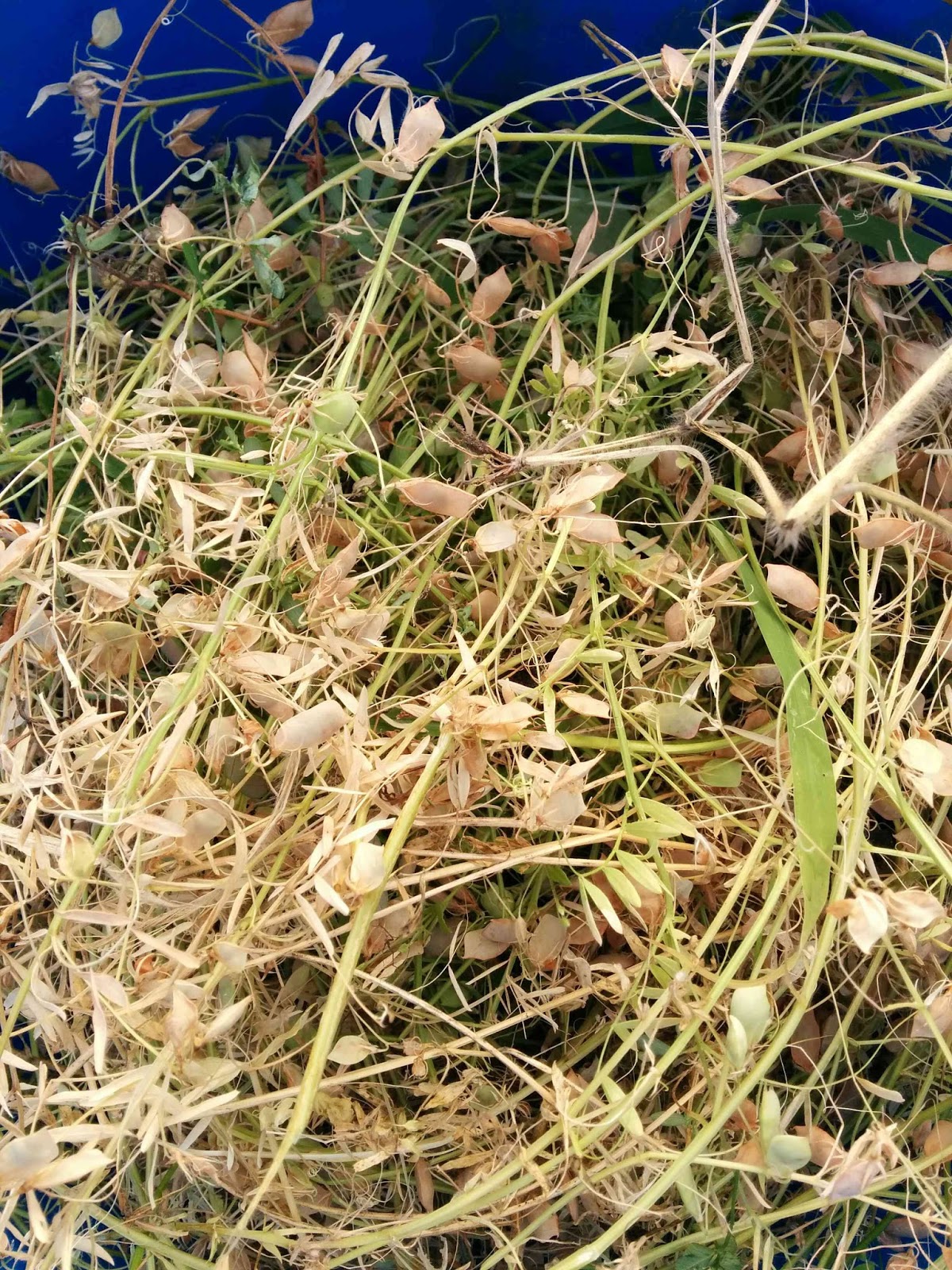
The pillowcase-and-baseball-bat threshing technique worked well to release the lentils from their pods. Then I removed the stems of the plants and tipped the remaining material from one plastic container to another, in a light breeze, to winnow out the last bits of straw and seed-pods.


From about 20 lentil plants, I recovered about half a cup of lentils (80g). Enough for one meal, perhaps, which perhaps doesn't sound too impressive. There are around 160 lentils in 5g, which gives a total yield of around 2,650 lentils in my batch.  I probably only sowed about 20 lentils to begin with, so that's a return of 13,150% on my initial investment, which is nothing to sniff at.


I'll keep a lot of these seeds for next year and grow a bigger patch outside, if I can devise a way of protecting the seedlings from rabbits!

23 July 2015

New harvests

I'm growing lentils this year and the time has come to harvest my first crop. Last year I tried growing them outside and every last plant was eaten by rabbits. This year I grew them in the greenhouse for a bit more protection.

I've been doing some research to find out the best way of processing the crop, and it seems that pulling the entire plant and leaving it to dry for a few days is the best approach. Then I should be able to thresh the plants by putting them in a pillowcase and bashing them about a bit, before separating the lentils from the straw.


Out of curiosity, I broke open a few of the pods to see what the lentils look like. The variety is Le Puy, which is the famous lentil grown in that region of France. There, they grow in a volcanic soil which gives them a unique flavour and in the European Union you can only call a lentil a Le Puy lentil if it is grown in that region. I suppose those types of rules don't apply outside the EU, but I don't know what you're supposed to call a Le Puy lentil if you grow it somewhere else! They are an interesting colour: basically green, but with blue marbling on them.


The other crops I've been researching harvesting techniques for are those in my 'grain patch' for this year. These are also new for me. From right to left in the picture below are: hull-less oats, Sangatsuga barley and Red Fife wheat. There's quite a bit of hop-clover growing underneath them, which I've left there, as it adds nitrogen to the soil and I don't think is doing the grains any harm.


These aren't ready to harvest yet, but they are definitely changing colour. Here they are in more detail - the oats:


The barley:


And the wheat:


My plan for these so far is to save the grain and sow a bigger patch next year, with the eventual aim of using it as feed for the chickens. Or maybe even eating it ourselves!

06 July 2015

Belated Canada Day blooms

I generally start the growing season with some sort of plan for the front garden bed that I can see from the kitchen window, but they rarely work as I expect them to. I grew cosmos this year, but only two of the plants survived and they are currently very tiny and spindly.  I also planted some miniature sunflowers, which have come up and should be flowering soon.

Star of the show at the moment though are these poppies, which I am fairly sure I did not sow. I don't know where they came from, but they're very pretty, and with the cilantro blooming at the same time, they are looking very patriotic. Shame they came out just after Canada Day!


A lot of this bed is given over to perennial edibles: sage, lovage, borage and horseradish, so the annuals have to be squeezed in between those. The bees and wasps love the borage and lovage: at one point this week I counted eight blue mud dauber wasps enjoying the lovage flowers. These wasps aren't at all aggressive and they eat spiders, so if you're not of fan of spiders, these are the good guys!


02 July 2015

A greenhouse perambulation

There are six raised beds in our greenhouse and at this time of year they're all in use for various crops. I love going in there and checking on progress, tidying things up and pulling weeds or overgrown lettuces. There are a lot of the latter: I let some of last year's lettuce go to seed and lots of it came up in the spring, in addition to what I sowed myself. Luckily the chickens adore it, overgrown or not, so it doesn't go to waste.


Bed 1 is the first one we built. This year it is full of a range of heirloom tomato plants, with some basil and the inevitable lettuce plant (I'll save the seeds from the two dark red ones you can see in the front here). Most other years I've had problems with blossom end rot on the big tomatoes, but so far so good this year. I put a good layer of chicken manure in this bed before planting it, so maybe that has helped.


Bed 2, the next one along, houses a huge sage bush and some more basil and lettuce (out of shot here). There are three okra plants in this bed - they are only just getting growing properly now, after a cool start to the season. They really need the protection of the greenhouse to put on growth, but they should take off in the next few weeks. There is already one pod forming on the biggest plant - although I managed to miss seeing the flower open! Behind them are a few late tomato plants (sown after I lost the outside ones to the late May frost). The white flower is a cilantro/coriander plant. They are great for attracting pollinators.


Bed 3 was my brassica nursery bed and I left a couple of kale plants in there for an earlier crop - they're producing lots of leaves already, while the ones I transplanted outside are about half this size. Behind the kale are lentils - my first year of successfully growing these (the rabbits got them last year when I sowed them outside!). In the rest of this bed I replaced the transplanted brassicas with beets and some carrots. They are being bothered by a nest of ants, so I've transplanted some sage into the bed, because ants aren't supposed to like it. Doesn't seem to be having any effect so far, though!


Bed 4 was my pea, parsnip and lettuce bed. The peas (Green Arrow and Little Marvel, with Oregon Sugar Snap at the back) are going over now, but I'll keep some to save as seed. I'm slowly pulling up the lettuce for the chickens and in the centre of this bed are my eggplants. Like the okra, they've been slowed up by the cool weather we've been having, but this week they've started to put on more growth and I'm hopeful they'll produce a good crop. It'll help when I pull out the peas which have been shading them, too. I've got three eggplant varieties this year: Applegreen, Korean Early Long and Rosa Bianca. They are all from Baker Creek, although they don't seem to do the Korean Early Long variety any more. These were from a 2012 seed packet, mind you!

Bed 5 is mainly peppers, with some carrots, beets, chard, later-sown tomatoes and already-going-to-seed spinach (I'll save that, too). This bed was also full of self-sown dill and I've been steadily pulling that out to avoid having the same problem next year! Most of the peppers are doing fine - I've put tomato cages round them to give them a bit of extra support before the fruit start coming. I find tomato cages good for peas and cucumbers, too. Note that I use stakes for the actual tomatoes!


A few of the peppers are very pale and a bit small - I'm not sure if this is a defect of the variety (I have failed to label them, as usual!) or a defect of their soil. Since they are all growing in the same place, it would be odd if that were the case, but I'll have to wait for the fruit to form to see if it's the variety that's the problem.


Bed 6 was only supposed to be melons and cucumbers, but the self-sown lettuce took over in here - even growing on the floor! There's still quite a lot of dill in this bed, too.


I haven't grown watermelons before and I didn't realise how huge the plants get. I pulled the cart up to support this one melon, but it's already grown through the end of the cart. I think it's going to take over the whole greenhouse!