09 June 2008

Leafing legumes and ailing aubergines

I'm not sure what this wildflower is. It has quite a distinctive flower and leaf (visible at the bottom of the picture), so I'm sure someone will recognise it!
Pea-like wildflower

[Postscript - it's American Vetch (Vicia americana).]

I found it as I was doing a tour of the vegetable garden this evening to assess progress. The Lincoln peas have finally started to appear:

Lincoln pea seedling and ladybird

and the broad (fava) beans have started to emerge, too:

Broad bean seedling

In an area very over-run with weeds, I even managed to track down my carrot and parsnip seedlings:

Carrot and parsnip seedlings

The recent spell of very warm weather has really started to move things on. The only plants that are looking very sorry for themselves are the Ping Tung aubergines/eggplants, which the word 'pathetic' doesn't really begin to describe. It's just as well that this picture is out of focus, I think.

Getting into hot water

 Evacuated tubes on garage roofWhile I was away the solar hot water system was installed back at home. Here is the array of evacuated tubes, perfectly placed to get the most of the sun hitting the garage roof. The tubes' heat is transferred to pipes containing a glycol/water mixture (so they don't freeze in the winter), which is then transported to the basement.

Basement hot water setupDown in the basement there is a new hot-water tank which is warmed by the pipe containing the solar-heated glycol mixture. This then feeds the old electrically-heated tank with pre-warmed water. The old tank had two heating elements inside it and one of those has now been turned off. An LCD display on the new tank reports the temperature at three different places in the new system. We'll be monitoring our electricity usage to see how much we save by pre-heating the water.

06 June 2008

Hot in the city

 I'm in Windsor for a conference. The city is humid, hot, noisy and dominated by a huge casino and the Detroit skyline. Trying to think of something nice to say about it. Um.

The park along the Detroit river is pleasant and Walkerville has some interesting late-nineteenth and early-twentieth century buildings (courtesy of the Hiram Walker whiskey empire).

I approve mightily of the city's gung-ho approach to litter. Every garbage receptacle has an anti-litter message emblazoned upon it. Although I thought this one was a bit ambiguous...

03 June 2008

Warning: horrors in store

 Ribston PippinHere we have the embryonic orchard (the tree closest to the camera is a Ribston Pippin), growing away well and looking gloriously healthy. But is it all too good to be true?

Just as in a horror film, there is danger lurking in the bushes: the interesting-looking structure below is a cedar-apple-rust gall with its 'telial horns', one of a number growing on a red cedar (Eastern Juniper) tree close to the orchard.

Cedar-apple-rust gallThe spores in these horns are released during wet spells (like today's) and will spread to apple trees in the vicinity. The affected apple trees will release their spores in late summer, ready to re-infect the cedars. I noticed the galls the other day and thought 'Aren't they pretty?'. Now I feel differently about them. Sometimes ignorance is preferable!

Seasonal pond, 3 June 2008So today's rain may be bad news for the apple trees, but at least the tadpoles have got their pond back. It was down to three large puddles on Friday. The weather is due to turn hot and dry after today, though, so they're still living on borrowed time.

The beginnings of botany

 Cover of Anna Pavord's book 'The Naming of Names'Anna Pavord's The Naming of Names is a wonderful read for anyone with an interest in plants. I've just reviewed it over on LibraryThing, but wanted to mention it here as well. Its focus is the way in which plants have been categorised and described over the years (starting in the 4th century BC), but along the way it covers the exploration of the world and the discovery of new plants (from a European perspective, anyway): from tulips and fritillaries to sunflowers and tomatoes. There are dozens of portraits (of plants and people) decorating almost every other page, making the book a delight to look at as well as to read.

02 June 2008

Poppy explosion

Poppies in flowerThe poppies have turned out to be downright blowsy, especially with the morning sun shining through them. There's a tall shrub behind them with small pink flowers (yes, it clashes wonderfully with the orange poppies) that I haven't ever noticed before. I'm not sure what it is: it looks a bit like a honeysuckle from a distance, but close-up it looks quite different. Here's a picture of it (click on the image for a closer look) - please post a comment if you recognise it!Unidentified pink-flowered shrub

29 May 2008

Pea mystery and amphibian worries

I sowed two half-rows of peas (Lincoln and Oregon Sugar Snap II) and a row of broad (fava) beans a few weeks ago. The sugar snap peas have all germinated beautifully, but there is no sign at all of the Lincoln peas or the broad beans. I went for the 'untreated' option on the peas, so maybe they just rotted in the soil (which was, I will admit, pretty wet when I sowed them).

I've re-sown them all, although it is probably far too late to be sowing broad beans now. They are on the north side of the peas, which will give them some shade when it starts getting hot. Assuming the peas do eventually germinate, that is. The soil is at its (very transitory) Goldilocks stage of not-too-wet and not-too-dry at the moment. It is rich and brown: the texture and appearance make me think of Oreo cookie dough.

I missed seeing the frogspawn in our seasonal pond, but noticed quite a lot of toad spawn in the permanent pond this morning. The seasonal pond is drying up fast and the tadpoles are being squeezed into a smaller and smaller space each day. Rain is forecast for the weekend (naturally), so I hope that will replenish the pond somewhat and give the tadpoles some chance of becoming frogs. Otherwise I can forsee myself feeling compelled to launch a rescue mission and having to ship tadpoles by the bucket-load from one pond to the other.

27 May 2008

Eye of the beholder

Poppies, ready to burst into flowerThe tenant who was in the house last year cut these poppies down to the ground before they had a chance to flower, according to one of our neighbours. Perhaps he thought that they were weeds. I'm sure they'll be lovely when they open up, but I think they look wonderful like this, weighed down with potential.

Where it's been too boggy to cut the grass, the dandelions have been thriving. These are generally considered weeds - but close-up they're beautiful, too.
Dandelion seed head

26 May 2008

Creatures, great and small

After a few days away it was time for a tour, to see what has changed. The temperature has been on the cool side, so there hasn't been much growth in the vegetable garden, although the potatoes are poking through the ground now (and the weeds seem to be burgeoning).

I somehow missed the frog-spawn phase, but we now have tadpoles by the hundred in the temporary pond in front of the vegetable garden.


This area of water is shrinking fairly fast (the streams are drying up quickly now), so it will be touch-and-go whether these little tadpoles make it to frog-hood before their pond dries up. In the stream a number of tiny water-snails had appeared, cleverly disguised as small grey pebbles. I haven't been able to find out what species they are.


The robins are still tending the nest in the barn, though no sign of any young this morning:


Up beyond the pond we spotted something furry moving around in next-door's field. Baby deer? Fox? Racoon?

First glimpse of a racoon

I've mainly seen racoons at the roadside at night-time, so wasn't really expecting it to be one. They're generally viewed as a bit of a nuisance round here, but I was thrilled to be able to get these photos.

Head-on view of racoon

It seemed to be feeding on something in the water. Tadpoles, maybe...

Racoon feeding in water

21 May 2008

Too perfect?

Temperate Palm House, Royal Botanic Gardens, EdinburghI arrived in Edinburgh this morning after a day of travelling and my hotel room wasn't ready, meaning I couldn't immediately rest and recover. So I dropped my bag there, eschewed the shops of Princes Street and the tourist traps of the Royal Mile and instead walked up to the Royal Botanic Gardens at Inverleith. This is a lovely oasis of calm in the city, with hundreds of mature trees and a variety of specialised gardens. The garden has been on its current site for nearly 200 years and the Temperate Palm House, pictured here, was built in 1858.

Rhododendron collageAt this time of year the rhododendrons are looking particularly splendid, as were the rock gardens. The place was lively with school parties, mothers out with their toddlers and many other folk who, like me, were wielding their digital cameras. The visitor information states that "photography and sketching are allowed for private use; special permission is required for commercial photography".

Rock Garden, Royal Botanic Gardens of Edinburgh That seems a bit over-sensitive (or over-controlling) to me, although I wouldn't be likely to be selling any photos, myself! Jogging is also forbidden, which is another rule I'm never going to break, but which seemed a bit harsh. I wonder whether there is a squad of super-fit Royal Botanic Gardeners employed to run after any miscreant joggers to stop them from... well, what? Breathing too noisily? Damaging the paths by treading too heavily? Not having time to read the labels?

Blooming BroomAll the labels and carefully maintained and delineated plants got to me after a while. It's all a bit too formal and structured for my taste (and contemplating the huge amount of work involved in maintaining this perfection was plain scary), although I do appreciate that the whole point of the place is to study and maintain the diverse plants. At the point where I was beginning to feel uncomfortable about the precisely-arranged nature of the site, I found the Scottish Heath Garden, which is a recreation of a Highland landscape. This was much better - more rugged, untidy and much more natural. The broom was flowering and looking beautiful.

18 May 2008

Babies (avian and vegetable)

Barn swallow chicksThe other nest in the barn belongs to a barn swallow family, whose two chicks peer out of the mud-and-grass construction. The parents are harder to spot, keeping well away when we're anywhere near the nest. I hope they're busy catching black flies, which aren't the aphids that British people think of when they hear those words, but an altogether nastier species of biting insect which is related to the mosquito. We hadn't encountered them before this month and I wouldn't mind if I never met one again. They like running water, so I hope once the streams dry up the supply of black flies will dry up too.

Potato sprouts and rootsI dug up one of the potatoes I'd planted last week, in a spirit of scientific interest. Well, actually I was wondering whether anything was happening underground and couldn't resist having a look. They are busily producing small roots alongside the green sprouts, so things are progressing as they should.

Florence fennel seedlingThis morning's job was to transplant the leeks and Florence fennel. Rain is forecast for the afternoon, so it seemed a sensible time to get on with it, although the leek seedlings are still fairly small. I've not grown fennel bulbs before, so it will be interesting to see how they get on. I haven't bothered putting up a photo of a leek, as they just look like very thin blades of grass.

Red cabbage transplantThe red cabbage seedlings have completely changed colour since I put them in the ground last week. I wondered if this was a sign of a problem with the plants, but have since discovered that they are a kind of litmus paper and will change colour depending on the alkalinity of the soil (you can even use them to make your own pH indicator juice). As we're sitting on limestone bedrock here, only a couple of feet below the surface, our soil is about as alkaline as it gets. Which is great for cabbages!

15 May 2008

Beyond the barnyard

After a hectic week of weeding, sowing and planting in the barnyard, it's good to wander in the woods behind the barns to see what's growing there, where I plan to do no interfering with the natural flora. I was hoping we might have some wild trilliums of our own, but I didn't see any. There were lots of dandelions (loads of those around the house, too) and a few clumps of wild violets (these are also popping up in the front garden, so have weed-like tendencies):

Northern blue violet

Further on I was surprised to find this:

Wild strawberry

Which has got to be a wild strawberry, hasn't it? There was only the one plant, though, and whether I'll be able to find it again when the flowers have become strawberries is another matter. I suspect the racoons or rabbits will get to them first.

12 May 2008

Oops, overdid it with the brassicas

My brassica bed was full of brassicas on Saturday. Now my potato bed is also full of brassicas and they've overflowed to take up half the root vegetable plot too. I think I got a bit carried away with sowing them, as I now have 'so much space'.

New vegetable plot, 12 May 2008Luckily I know this guy with a tractor...

Sometimes I worry that I'm pathetically easy to please (some might say cheap). Expensive jewellery, designer clothes, flashy foreign holidays? Nope - a nicely ploughed new vegetable patch will do me just fine. Thanks, Mike!

11 May 2008

Progress on the plot at last

DrainageThere are two streams running either side of the barnyard. The one to the west runs straight downhill to the ditch at the roadside, but the one to the east petered out at around the vegetable plots. Hence their sogginess. So Mike got to work and created a proper ditch this morning, which has channelled that water away from the vegetable patch. By the time we got back from our outing this afternoon, the difference was noticeable and all the beds were a lot drier.

Tomatoes in the soilWe got to digging them over and managed to plant 16 tomatoes. In the morning I'd sown the broad beans and half a row each of Lincoln and Oregon Sugarpod peas. It seems strange to be putting the peas in at the same time as the tomatoes, but given the wetness of the soil there was no way they could have gone in any earlier.

Unidentified brassica seedlingYesterday I'd put two seed-trays full of cauliflowers and broccoli (calabrese) into the brassica bed. Well, all bar one plant that the dog decided to eat. He didn't eat any more, so I hope it tasted disgusting. He'd also stolen the labels from the trays, so I had no idea which was broccoli and which was cauliflower. I'm sure it'll be obvious in a few months' time...

Our tools are all kept in the small barn, which is missing a door and part of a window, so is an attractive home for nesting birds. I feel guilty every time I have to go in there, as the robin sitting on this nest usually flies off in fright. I hope they have better luck than the ones that nested on top of the garage light last year.

Official symbols

Black SwallowtailOur first brush with officialdom today was this female Black Swallowtail butterfly that Mike spotted in the barnyard. It's been the official State Butterfly for Oklahoma since 1996. I notice that Oklahoma even has a state beverage: milk. This is also the sole state beverage for 15 other states. Does that seem a bit odd to anyone else?

Ontario's list of official emblems is somewhat shorter than Oklahoma's, although I'm dubious about the need for the Act establishing an official tartan - maybe 2000 was a quiet year for law-makers in the province.

Trillium GrandifloraAnyway, the official flower for Ontario is the white trillium (trillium grandiflorum) and there were lots of them flowering in Presqu'ile Provincial Park this afternoon when we went out for our Mother's Day walk. We'd never seen them before - they are beautiful.

09 May 2008

Water gardening

Root bed, 28 AprilThis was my root vegetable plot 11 days ago. It was still underwater today (there was pond-weed growing in it, for heaven's sake), so I decided to try digging some drainage channels down the sides of it to help get rid of the water. Mike used his mattock to extend the channels down the slope beyond the fence and by late afternoon the bed looked a bit less soggy:

Root bed with drainage channelsIt might even be possible to get my parsnip, beetroot and carrot seeds sown one day soon! Most of the other beds are still pretty boggy, too, although the garlic and shallots do seem to be sprouting despite sitting in puddles. One of the semi-submerged asparagus crowns that I couldn't fit into the tyres has started sprouting too, which seems amazing.

Captured frogThe planned potato and pea/bean beds are both still pond-like at their southern edges: wet enough to be providing homes for a couple of frogs. Child #1 proved rather better than the dog at catching them.

06 May 2008

Time-eating websites

Blotanical


I started reading other gardeners' blogs a few months ago and was led by one of them (Earthwoman's) to the Blotanical site. It's a social networking community for gardeners and a way of promoting your own garden-related blog. I'd already followed a lot of these blogs using Netvibes, my feed-reader, but Blotanical brings other benefits, like being able to pick posts that you like, send short, friendly messages to other bloggers and see where in the world they are. Blotanical was launched by garden blogger Stuart Robinson (who's based in Western Australia) last December.

I was a bit dubious about the points system at first (the more use you make of the site, the more points you get), but even that gets a bit addictive after a while. The only suggestion I have for improving the site is to make it possible to add a blog as a favourite when you're viewing it in the 'picks' section. At the moment it seems to take a while to find the blog and add it (although I may have missed an easier way of doing this). Also the flashing adverts are annoying. And while I appreciate that setting a cookie means that I don't have to log in every time I visit, this does mean that I don't gain a point for logging in, which seems a disadvantage of doing this (though I'm trying not to get too hung up on the points thing, honestly!).

Traffic to this blog has certainly increased since I joined and I've found a lot of other interesting blogs from all over the world to read and learn from. You don't have to be a blogger to join - anyone can sign up.

LibraryThing


Another online community I've joined since moving here. I don't spend as much time on it as I do on Blotanical, but I am diligently adding and reviewing the books I read. I use it a lot to find new books or authors, as its suggestions are based on books people have actually read, unlike Amazon's, which are based on books that I've bought (often for other people).

05 May 2008

Dog vs. Frog

Two frogsSince the frogs re-emerged, the dog's favourite pastime has been patrolling the long stretch of water currently taking up the area in front of the vegetable garden, trying to grab one. He hasn't managed to catch a frog yet, but will happily splosh up and down for half an hour at a time. You can almost hear the frogs sniggering at his efforts. If you look very closely at the video clip, you may be able to see a frog swimming away at top speed.

04 May 2008

Field of sticks

Orchard, the day after planting, 4 May 2008
We have an orchard! Well, actually, we appear to have a field of sticks tied to other sticks, but in my imagination they're just oozing with potential. In my plans for the orchard planting work I pictured Mike digging the holes with the tractor and me planting the trees. Easy, right? Er, no. I failed to factor in the physical effort involved in filling the holes in again, which obviously (I now realise), you can't use the brute force of the tractor for. It was stupendously hard work. By about the third tree I was wondering if planting an orchard had been such a brilliant plan, after all.

Things got a bit better once Mike had finished digging the holes (by which time I'd planted nine out of the 17 trees), because then he was able to help with the filling-in (he's got the shoulders for this kind of work - I'm built more like the spindly apple trees). It took five hours to get all the trees in the ground, staked, pruned and watered. The staking was a good bit of recycling: the stakes are bits of wood that were lying around the farm (some old fence posts, others branches from the poplars we had cut down last year) and I made the ties holding the trees to the stakes from an old pillowcase (Canadian pillows are bigger than UK ones, so I figured it was unlikely I'd need the pillowcase again).

By the time we'd finished we were exhausted, but very pleased with ourselves. Then we were rewarded with seven hours of steady rain, which should have soaked the trees in well.

In other news, over in the 'tyre garden' the very first asparagus shoots have emerged:
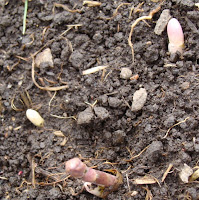
First asparagus shoots

And two out of the three rhubarb crowns are showing signs of activity too. Here's the better looking one:

Rhubarb emerging

As the vegetable garden is still more pond than plot, I've sown spinach, rocket (arugula), chard and lettuce in the front garden, in a bed which I had originally planned would only hold flowers and herbs. For the record, here's how that looks at the moment:

Front garden bed, 4 May 2008

Squirrel-planted tulip in lawnI've also been busy rescuing tulip bulbs. Last summer the black squirrels took great pleasure in digging up the tulips and redistributing them all over the lawn. So far I've dug up about twenty bulbs (luckily the squirrels plant them very shallowly, so this isn't too difficult). They did the same thing to one of our neighbours' tulips, but replanted them in someone else's lawn. I wonder what the etiquette is concerning rescuing one's own tulips from a third party's garden?

These are the same squirrels that were living in our roof-space this time last year. At the St. George's Day party, I learnt that they have now crossed the road and taken up residence in our neighbour's (the one with the tulip-filled lawn). She told us that she has been trapping the squirrels and shooting them with a pellet gun. I think I might have been shocked by this a year ago, but now I am quietly pleased that she is taking care of the squirrel menace and find myself singing lines from Tom Lehrer's Poisoning Pigeons in the Park:
And maybe we'll do in a squirrel or two,
As we poison the pigeons in the park.