11 July 2009

Degonwadonti

The male chicks attracted names early on, as they are both easily spotted and their combs are sufficiently different to make distinguishing between them easy. This might be a terrible mistake, as one of them is probably going to end up as a meal. The females are all very alike still, so names for them are slower in coming. There is one whose face is currently darker red than the rest, so she is Rosie for the time being, but I'm fairly sure that the others will soon come to look like her, so that name is unlikely to stick (unless we call them all Rosie, of course).

The chick pictured has a distinctive Mohican/Mohawk feather arrangement on her back, which has been like that for a couple of weeks now. So I think of her as Degonwadonti*, which is the Mohawk name for Molly Brant, who was quite a remarkable woman. She died in Kingston in 1796, just up the coast of Lake Ontario from us.

*I've also seen Koñwatsi-tsiaiéñni as her Mohawk name - but Degonwadonti looks slightly easier to pronounce!

10 July 2009

Set/Seed

I've only ever grown maincrop onions from sets before and last year's onion crop was non-existent, thanks to my sets rotting in the soil. This year I grew onions from seed, sowing Early Yellow Globe and Sweet Utah seeds in January indoors. By early April I'd transferred them to the greenhouse:


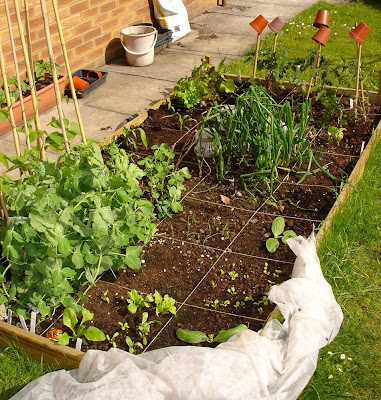
They went into the soil of the upper vegetable garden (which is drier and warmer than the lower garden where I'd put the sets last year) on April the 14th.

The bed has required a lot of weeding, as onions don't block out much light to suppress weeds, but that would have been the case if I'd grown them from sets, too. I'm really pleased with the way they've come on. I pulled the first onion yesterday and most of these will go into winter storage in the cellar. I hope that it will be a while before I have to buy any in the stores. I'll definitely be growing onions from seed again next year - it wasn't nearly as hard as I'd thought it would be.

08 July 2009

Nursery food (and a glimpse of Scotland)

I wandered up to the hayfield this evening, hoping to get some good cloud photographs. The dark skies weren't quite as impressive as I thought they might be, so I went to have a look at the Common Milkweed (Asclepias syriaca) flowers, which had been nearly open the last time I looked at them. It is a very distinctive plant and is well-known for its role as a host to the caterpillars of Monarch butterflies.


The leaves contain a poisonous sap, but the flower buds are edible if thoroughly cooked (I haven't tried this, yet). As I looked at the plant I was thinking that I have yet to see any Monarchs this year. Then I realised that there were two Monarch caterpillars on the milkweed that I was photographing, so there must be some around:


The dark clouds might not have been that photogenic, but I did like this white one, which seemed to resemble a map of Scotland. Or the way I draw the map of Scotland, anyway (i.e. a bit vague and woolly around the west coast):

06 July 2009

How does your garden grow?

We measured the area of all the vegetable-growing space yesterday (just the beds, not the paths between them). I've described before how I started growing food in earnest (rather than just growing a few parentally-donated tomato plants in gro-bags, which is what I usually did prior to 2005) in our back-garden in Manchester. By 2005 we were already planning to emigrate, so it wasn't worth trying to get an allotment, although there were some allotment plots within walking distance of our house. To be completely honest, the idea of having such a public space to learn in would have put me off, too - I like to experiment in private!

So, my total growing space for vegetables in 2005 (one raised bed) was 32 square feet (3 m²).

In 2006 we added another bed, bringing the total to 64 square feet (6 m²).

By 2007 we were in Canada. Arriving in late June meant that we had no space or time to grow vegetables, but that summer we did plough up part of the barn yard and create eight vegetable beds which were planted with buckwheat as a green manure. Total growing area: 1,059 square feet (98 m²).

Two more beds were created in the spring of 2008, brining the total to 1,540 square feet (143 m²).

In 2009 we have the three greenhouse beds and one more bed in the upper part of the barnyard, so the grand total now is [fanfare] 2,143 square feet (200 m²).

I don't really plan on expanding the outside vegetable beds any further: keeping on top of the weeding would just be impossible. There might be some more greenhouse beds next year though, so the figure is likely to climb again. It is quite amazing to think that my vegetable garden is now 66 times bigger than it was in 2005. It certainly won't all fit into one photo any more!!

05 July 2009

Musical interlude


Tents, a portable convenience*, wellies and light sabres. Must be summer music festival season! This particular event, Lakestock, is in its third year and is organised by a family who live just a kilometre away from us. A home-grown music festival that we can walk to and that isn't too crowded. My idea of a perfect way to spend a Saturday afternoon. There was a good mixture of original pieces and more familiar songs in a range of different styles (from opera through Show Boat to songs by Blondie, R.E.M. and The Killers). There was also great food and it was another chance to meet up with many of our neighbours.

One set of neighbours that we hadn't met before were a couple who had bought the separate piece of farmland that had been owned by the previous owner of our house. The land is further down our road. They are building an off-grid rammed-earth tyre/tire house there, which makes our green initiatives seem rather tame in comparison!

The journey home was a pleasant evening stroll along the lake. Perfect.


*I couldn't remember if this was provided by 'Bob's Johns' or 'Bill's Johns'. A quick search revealed that companies with both names are in existence. I had an infantile chuckle at the motto of the former (based in Durango, Colorado): "We boldly go where you've gone before".

01 July 2009

Growth spurts

The way things grow at this time of year staggers me. In the greenhouse, the tomatoes looked ridiculous on the 18th of May, when they were dwarfed by the long stakes I had planted them next to.


Now they don't look quite so stupid and I'm thinking that I planted them much too close together!


On the same day in May the chicks looked like this:


Now they're looking a lot more like hens:

30 June 2009

Locavorous luncheon

Old friends of my family came to visit today. I went to school with their daughter and have met up with them at family get-togethers in England many times. Their son lives in Toronto, so they are visiting this country and came with him and his family to see us for the day.


As they are regular readers of this blog, I felt honour-bound to use as much of our home-grown produce in the lunch as possible and this was the haul I garnered from the vegetable patch this morning. The potatoes were just about big enough to pick - we had Caribe (the purplish ones), Linzer Delicatesse (the yellow ones) and some Shepody (the other ones!). We also had the first of the meat from our local CSA scheme (which delivers 20lb of locally- (and ethically-) reared meat once a month): lamb mince which I made into kofte kebabs. We washed it all down with local wine and beer, so all-in-all a meal that would make any locavore proud.

It was a really lovely day, and great to see everyone. The two little ones were a bit traumatised by the size of our dog, but I hope they soon recovered from that!

27 June 2009

"Soil is death"

Heard a brief but inspirational interview on CBC Radio's Definitely Not the Opera this afternoon. The whole programme was about waiting and it ended with a woman called Catherine Richard (not sure of the spelling), who is terminally ill with ovarian cancer: waiting to die. She has completely reassessed how she wants to spend her remaining time and when the weather is good, she chooses to spend her time gardening. In her words:
Well, when you think about it, soil is death. It is decomposed life and out of that decomposed life comes food and beauty and all the things that we rely on for living. So you can't be a gardener and be afraid to die because you know that everything just gets recycled through the soil.
The whole podcast is available for download and this segment starts at around 53 minutes into the programme.

26 June 2009

No cats and dogs, but chicks and frogs

Big black clouds have come and gone and have clearly deposited a lot of rain on neighbouring areas, but not much on us.


The little rain we have had was the first that the chicks have experienced, as their outside run is now fully connected to their corner of the barn and they can choose whether to be inside or out. I watched some of them use their run while it was raining and they spent a lot of time shaking and fluffing out their feathers.


The sweet peas are flowering in front of the veranda, but aren't quite as spectacular as I'd hoped. Probably because it's been so dry and I haven't watered them as much as I should have done. They do smell lovely when we sit on the veranda, though.


Yesterday there was a disruption to the usual routine when a set of trainee journalists from the local college turned up to make a film recording our various green installations. This was a follow-up from the green homes tour we were involved with in March. Mike did some talking, then they filmed various things. I stayed out of it! I think the end product will appear on the Internet at some point, so I will link to it when it does.


We're picking lots of peas at the moment and the greenhouse tomatoes are coming along well. This is one of the Amish paste tomatoes.


I'm also finding a lot of self-sown Riesentraube tomato plants coming up in what is now one of my brassica beds. Makes me wonder why I mollycoddle the tomato plants indoors for weeks, when they self-seed so readily outside!

I did a lot of weeding and some succession sowing of carrots, beetroot and lettuce at the weekend and have been watering those beds this week. I don't bother to water the more established plants, but obviously the greenhouse needs watering each night. The newly-sown carrots are already up, which seems very quick. With the dry weather the seasonal pond has dried up and, unfortunately, so did the tadpoles. There still seem to be a good quantity of adult frogs around, though. This one was watching me as I weeded the tyre garden. I still feel rather guilty about not trying to rescue the tadpoles - so that look in its eye seems a bit accusatory.

20 June 2009

Chick update

This picture shows the clear difference that is now visible between the male and female chicks. Two of our dozen turned out to be males. I didn't want any, really, but will keep one of them, as everything I've read seems to suggest that hens are generally happier with a cockerel around to protect them (and of course it will give us the opportunity of raising chicks from our hens next year).


Two roosters is one too many, however, for the number of hens we've got, so we'll have to turn one of them into meat at some point. Not just yet, though... The chicks are growing nicely - here's a picture of one of the females, to show how big they're getting. They're about eight weeks old now.


The canna rhizomes that my father and his wife bought for me in May are now beginning to send up shoots. Apparently cannas are a traditional gift for Father's Day in Thailand. Don't think mine are quite big enough yet to make a favourable impression as a gift:


As you can see from the canna photo, it's been pretty wet here today. It was a shame, as Deseronto had its Waterfront Family Festival, which would have been much better attended if the weather had been fine. I did manage to win a (rather gaudy) trophy in the baking contest for my Bakewell Tart, though:


We were given 12 pounds of frozen raspberries by one of our neighbours this week and I turned half of them into raspberry jam on Thursday evening. I used the jam in the tart, so it definitely fitted the requirement for cooking with locally-grown food!

17 June 2009

Two years on

Two years ago today we arrived in Canada as temporarily-homeless new immigrants. Well, not quite homeless as we still owned our old home in Manchester and were only two days away from taking possession of our house here. It's odd to look back over the last two years and reflect on what has changed in that time.

A lot of the things on our list of 'things we want to do in Canada' seem to have been crossed off. Although Mike occasionally complains that he has never actually seen the 'to do' list. Which is clearly the right way to manage such things, I'm sure you'll agree.

I feel that I ought to be writing something profound about our experiences at this juncture, but that is too difficult, so instead I will do what I normally do and stick to the pragmatic (and possibly mildly distasteful).

One of the enduring mysteries of this house has been its waste-management system. We sorted out the incoming water in various ways, but were never very clear about how to deal with the septic system that dealt with the outgoing variety. There was no obvious place from which to pump the waste out.

Yesterday, with the help of one of our neighbours (who pushed us into doing something by calling in a firm who deal with septic tanks), this was sorted out. The well-hidden entry point to the septic tank was located and a big lorry pumped out the tank in a very short period of time. It won't need doing again for another three years or so.


So that was another thing crossed off the list. But I'm sure that something else will come along soon and take its place.

Only don't tell Mike.

16 June 2009

First fruits

It's hard to believe that the orchard has only been in place for a year. It's coming on well and this year we're getting a few fruit forming on the trees.


Apricots:

Clapp's pears:

Meteor cherries:

Apples (these are Spartans, I think):


Stanley plums (which look exactly the same as the greengages right now):


The gooseberries are looking good, too:


In one corner of the orchard Mike is working on a bigger outside run for the chicks. The longer term plan is to allow the chickens to range freely in the orchard for at least some of the time. I hope they'll keep the bugs down. I need to train them to go back into the run when I want them to though, before I will feel comfortable about doing that.

14 June 2009

Rain please


The seasonal pond behind the house is drying up fast. It is packed with gasping tadpoles. Last year I took bucket loads of tadpoles up to the other pond when this happened, but I'm not going to this year. If these frogs are stupid enough to reproduce in this pond, then I really feel that natural selection should take its course.

There are some impressive cumulonimbus clouds around tonight, though, so with any luck they will produce some rain to add to the utterly measly 5.2mm (0.2 inches) of rain that we've had in June so far.

13 June 2009

Vegetable blooms

The greenhouse tomatoes are noticeably bigger than those in the garden and are just beginning to flower. This one is an unknown variety given to me by a friend. It is supposed to produce huge tomatoes, which I can well believe, looking at the size of the flowers. I've labelled these plants 'Cyril's Jumbos'.


Early in the spring, I sowed some broad beans in the greenhouse. I wasn't sure how well they'd do in there, but insects have managed to find the flowers and there are tiny beans forming on each of the plants. My crop of broad beans last year was negligible, so I hope this year I'll have more than a mouthful.


Last year's 'three sisters' bed was a bit of a failure as the corn did badly. This year it seems to be the turn of the runner beans to disappoint. Only three of them have come up (it was two year old seed, but even so...). Last week there only appeared to be one, so the situation isn't quite as dire as I had thought. I must be sure to save some seed from the beans this year, as I haven't any left now. The first batch of pumpkin and squash seeds for this bed also failed to germinate. I had them on the floor of the greenhouse and am wondering whether rodents might have got to them: I had the same problem with the peas in the spring. I re-sowed the squashes and put them up off the floor and this second batch have germinated fine.

The coolish weather has suited the peas (another rather disappointing crop last year). They've been flowering for a week now, and some small peapods are forming on the plants.


The chicks seem to be enjoying their new home. These two were inspecting the nest boxes this evening. The one we're calling 'Cocky' is becoming very friendly now and will jump up on your lap and sit still to be stroked. The female ones are more timid. My daughter and I find them fascinating, but the males in the family aren't particularly bothered about them. As my step-mother thought they were intriguing too (and my father didn't), I wonder if this is a general trend. Are chickens just a chick thing?

08 June 2009

3 x 2 x 4

The chicks looked so small next to the perches in their new house that I wasn't really expecting them to use them yet. But by this morning they'd worked it out.


What remarkably bright little things they are. The one in the middle looks like she's having a good nap.

07 June 2009

Barn conversion

Most of the things I've read about chicken coops assume that you're either building one from scratch or have bought a ready-made one. The Eglu, for example, seems to be the in-thing for suburban chickens. Our situation was a bit different, as we planned to convert one of the five stalls in our smaller barn into a home fit for chickens.

As the previous occupants of the barn were a lot bigger than chickens (limousin cattle), this involved a fair bit of work to ensure that the chickens wouldn't escape and that the coop would be safe from rats and any possible predators. The chickens were getting too big for their box, so we had to get this finished.

Mike worked hard all day yesterday on this and I joined in when I got home from work. I'm really impressed with the end result. You can see how we've built around the original structure below. The dark wood is what was there before and the lighter coloured parts are the bits we've added. We still need to add a lip (and maybe a perch) to the front of the nest boxes, but as the chickens won't be laying for about four months, this isn't urgent! There's room to add another layer of nest boxes on top of the first ones, if our flock expands in the future. There's certainly room for more chickens in this space.


We've put chicken wire above the edges of the stalls, so that there is still a fair bit of daylight coming in from the rest of the barn. The stall has a window in it too, which isn't shown in these pictures.


The nest boxes were cunningly situated against a gap in the original stall fence, so that we could put in this really neat hatch behind them. This will mean we can collect eggs from the nest boxes without going into the coop itself.


We introduced the chicks to their new home last night. They look ridiculously small in there now, but I'm sure they'll soon grow into it.

02 June 2009

Shake a tail feather

It's been too cold to let the chicks out for a couple of days, but today was warm enough and they got a run in their pen. Their heads still look a bit scruffy, but the rest of their bodies are feathering up beautifully:


I hadn't realised how delicate their feathers would be. Here's a close up for the other feather-fanciers out there:


Below is the chick that my dad's wife has dubbed 'Cocky' because of our suspicions about its gender. Are we right, or is this just a fast developer compared to the rest?


Mike picked up some plywood this afternoon so we're ready for the next big job, which is to convert one of the stalls in the small barn into a chicken home for these creatures.